
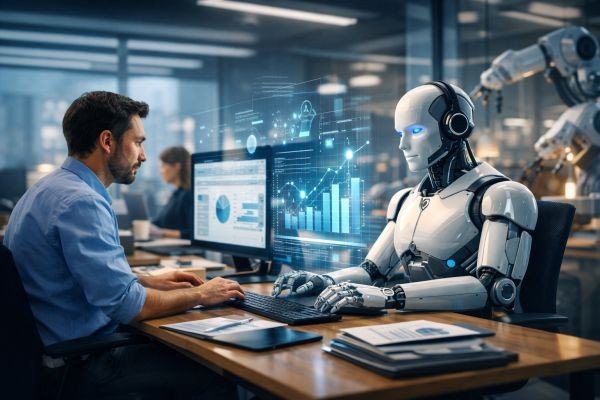
AI Agents Are Replacing Routine Work: What Skills Will Matter Next?
A Quiet Workplace Revolution Has Already Begun
Imagine arriving at work one morning and discovering that an AI agent has already completed half of your daily tasks.
It answered customer emails.
Scheduled meetings.
Analyzed spreadsheets.
Prepared reports.
Updated databases.
Even responded to routine client questions.
What once required several hours now takes minutes.
This isn't science fiction.
It's happening right now.
Across industries, AI agents are beginning to automate routine work at a speed few people expected.
For some, this sounds exciting.
For others, it sounds terrifying.
The biggest question isn't whether AI will change jobs.
It already is.
The real question is:
What skills will matter when machines handle most routine work?
The answer may determine who thrives in the next decade—and who struggles to keep up.
What Exactly Are AI Agents?
Most people are familiar with AI chatbots.
But AI agents are different.
Instead of simply answering questions, AI agents can perform actions.
They can:
-
Manage calendars
-
Conduct research
-
Write reports
-
Analyze data
-
Handle customer service
-
Coordinate workflows
-
Automate repetitive business processes
Think of them as digital workers rather than digital tools.
They don't just assist.
They increasingly execute.
And that's why businesses are paying attention.
The End of Routine Work
Throughout history, technology has repeatedly automated repetitive tasks.
The Industrial Revolution automated physical labor.
Computers automated calculations.
The internet automated information sharing.
AI is now automating routine cognitive work.
Tasks that follow predictable patterns are especially vulnerable.
Examples include:
-
Data entry
-
Basic customer support
-
Scheduling
-
Document processing
-
Standard reporting
-
Administrative work
This doesn't mean every job disappears.
It means many tasks within jobs will.
And that distinction is important.
Why This Time Feels Different
Previous technologies often replaced specific tools.
AI is beginning to replace specific capabilities.
Capabilities once considered uniquely human.
Writing.
Analyzing.
Planning.
Problem-solving.
Decision support.
For the first time, knowledge workers are experiencing the same disruption that factory workers experienced during earlier technological revolutions.
The impact could be enormous.
The Skills That Are Becoming Less Valuable
Not all skills age equally.
Some become more valuable during technological change.
Others become less valuable.
The most vulnerable skills tend to be:
Following predictable procedures
If a task follows clear rules, AI can often learn it.
Memorizing information
Information is abundant and instantly accessible.
Repetitive administrative work
Automation excels at consistency.
Basic content generation
Simple reports, summaries, and routine communication are increasingly automated.
The future rewards something different.
The Rise of Human-Only Skills
As machines improve, uniquely human capabilities become more valuable.
These are the skills AI struggles to replicate.
Not because they're complicated.
But because they're deeply human.
1. Creativity and Original Thinking
AI can generate ideas.
But truly original thinking often comes from lived experience, intuition, curiosity, and unexpected connections.
The future belongs to people who can:
-
See opportunities others miss
-
Create new solutions
-
Imagine new products
-
Challenge assumptions
In a world flooded with generated content, genuine creativity becomes increasingly rare.
And therefore increasingly valuable.
2. Emotional Intelligence
Machines can recognize emotional patterns.
Humans can genuinely understand emotions.
The ability to:
-
Build trust
-
Resolve conflict
-
Lead teams
-
Show empathy
-
Understand motivations
will become a major competitive advantage.
People often remember how someone made them feel long after they forget what was said.
That remains difficult to automate.
3. Communication Skills
Ironically, communication may become more important because of AI.
As information becomes easier to produce, clarity becomes more valuable.
People who can:
-
Explain complex ideas simply
-
Tell compelling stories
-
Persuade audiences
-
Build relationships
will stand out.
Communication transforms information into influence.
4. Adaptability
The most valuable skill of the next decade may not be coding.
It may be adaptation.
Technology changes quickly.
Industries evolve.
Job roles transform.
People who can continuously learn, unlearn, and relearn will have a significant advantage.
The future rewards flexibility over certainty.
5. Critical Thinking
AI can generate answers.
But humans must evaluate them.
As AI becomes more common, critical thinking becomes essential.
People need the ability to ask:
-
Is this accurate?
-
Is this ethical?
-
Does this make sense?
-
What are the risks?
The ability to think independently may become one of the most valuable skills in an AI-driven world.
6. Leadership and Decision-Making
AI can provide recommendations.
Leaders make decisions.
Organizations still require people who can:
-
Set direction
-
Inspire teams
-
Handle uncertainty
-
Accept responsibility
Leadership involves judgment, accountability, and human understanding.
These qualities remain difficult to automate.
7. Interdisciplinary Thinking
The future favors people who connect different fields.
Engineers who understand psychology.
Designers who understand technology.
Marketers who understand data.
Writers who understand AI.
Innovation often occurs at the intersection of disciplines.
The broader your perspective, the more opportunities you can identify.
Why Technical Skills Still Matter
Some people assume human skills alone are enough.
Not quite.
Technical literacy remains important.
The difference is that future professionals will work alongside AI rather than compete against it.
Understanding:
-
Artificial intelligence
-
Data analysis
-
Automation tools
-
Digital systems
will increasingly become basic career requirements.
The goal isn't replacing human skills.
It's combining them with technological capabilities.
The New Career Formula
For years, career success followed a simple model:
Knowledge + Experience = Opportunity
The future may look different:
Human Skills + AI Skills + Adaptability = Opportunity
People who understand both technology and human behavior will likely have the strongest advantage.
What Students Should Focus On Today
For students entering the workforce, the message is surprisingly encouraging.
Don't just focus on what AI can do.
Focus on what humans do best.
Learn:
-
Communication
-
Problem-solving
-
Leadership
-
Creativity
-
Emotional intelligence
-
Critical thinking
-
AI tools and technologies
The goal is not becoming better than AI at routine tasks.
The goal is becoming exceptional at tasks AI cannot easily replicate.
The Opportunity Hidden Inside Disruption
Every technological revolution creates fear.
But it also creates opportunity.
The internet eliminated some jobs.
It created entirely new industries.
Computers automated tasks.
They also generated millions of careers.
AI will likely follow a similar pattern.
Some roles will shrink.
Others will emerge.
The challenge isn't resisting change.
It's preparing for it.
Final Thoughts: The Future Still Needs Humans
The rise of AI agents marks a significant turning point in history.
Routine work is increasingly becoming automated.
Processes are becoming faster.
Efficiency is improving.
But this doesn't mean humans are becoming obsolete.
In many ways, it means the opposite.
As machines handle predictable work, human qualities become more valuable.
Creativity.
Empathy.
Wisdom.
Curiosity.
Leadership.
Purpose.
The future may belong not to those who compete with AI, but to those who learn how to work alongside it.
Because while machines may become extraordinarily intelligent, the qualities that make us deeply human still matter.
And in the age of AI agents, they may matter more than ever before.