
AI Agents vs Chatbots: What's the Real Difference in 2026?
Artificial intelligence has evolved faster in the last three years than most people expected. Not long ago, businesses proudly introduced AI chatbots capable of answering customer questions and providing instant support. Today, however, a new generation of AI is emerging—AI agents.
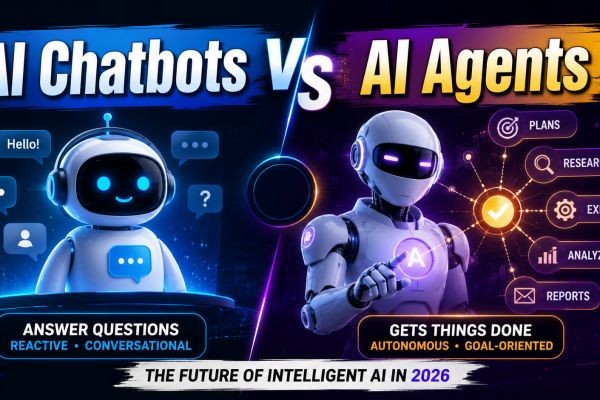
The terms chatbot and AI agent are often used interchangeably, but they represent two very different technologies. While chatbots are designed to respond to conversations, AI agents can reason, plan, make decisions, and complete complex tasks with minimal human intervention.
In 2026, this distinction matters more than ever. Organizations are shifting from simple conversational assistants to autonomous AI systems capable of managing workflows, writing code, analyzing data, booking meetings, conducting research, and even collaborating with other AI systems.
So, what exactly separates an AI chatbot from an AI agent? Let's explore.
What Is a Chatbot?
A chatbot is an AI-powered conversational program built primarily to answer questions or perform simple interactions through text or voice.
Traditional chatbots typically work within predefined boundaries. Modern chatbots powered by Large Language Models (LLMs) like GPT have become significantly smarter, but their main function remains conversation.
Common chatbot capabilities include:
- Answering FAQs
- Customer support
- Product recommendations
- Booking appointments
- Language translation
- Basic troubleshooting
- Educational assistance
Most chatbots are reactive—they respond after receiving user input.
Think of a chatbot as an intelligent receptionist waiting for your next question.
What Is an AI Agent?
An AI agent goes far beyond conversation.
Instead of simply answering questions, an AI agent is designed to achieve goals.
It can:
- Understand objectives
- Break complex work into smaller tasks
- Plan execution
- Use multiple software tools
- Search the internet
- Analyze documents
- Write reports
- Remember previous context
- Monitor progress
- Improve decisions based on outcomes
Rather than waiting for instructions every minute, AI agents can work independently for extended periods.
Imagine hiring a digital employee instead of simply using a digital assistant.
AI Chatbots vs AI Agents: A Quick Comparison
| Feature | AI Chatbot | AI Agent |
|---|---|---|
| Primary Role | Conversation | Task Completion |
| Decision Making | Limited | Advanced |
| Planning | No | Yes |
| Memory | Short-term | Long-term |
| Tool Usage | Limited | Multiple Applications |
| Goal-Oriented | Partially | Completely |
| Autonomy | Low | High |
| Multi-Step Tasks | Limited | Excellent |
| Collaboration | Minimal | Can coordinate with other AI agents |
| Learning Capability | Limited | Continuously improves workflows |
The Biggest Difference: Intelligence vs Autonomy
The biggest distinction isn't intelligence.
Modern chatbots are already incredibly intelligent.
The real difference is autonomy.
A chatbot answers.
An AI agent acts.
For example:
Chatbot
You ask:
"How do I apply for a passport?"
It explains the process.
Done.
AI Agent
You ask:
"Help me renew my passport."
The agent may:
- Find government requirements
- Check document validity
- Fill forms
- Schedule appointments
- Add reminders
- Track application status
- Notify you of updates
The conversation becomes only one small part of a much larger workflow.
Why AI Agents Are Becoming So Popular in 2026
Several technological breakthroughs have made AI agents practical.
1. Better Reasoning Models
New AI models can think through problems more logically before producing answers.
Instead of guessing, they evaluate different possibilities.
2. Long-Term Memory
Modern AI agents remember previous projects, conversations, and preferences.
This allows them to build context over weeks or months rather than starting from zero each time.
3. Tool Integration
Today's AI agents connect directly with:
- Calendars
- Excel
- Google Docs
- CRMs
- Coding platforms
- Cloud storage
- Databases
- APIs
Instead of talking about work, they actually perform it.
4. Multi-Agent Collaboration
One of the most exciting developments is multiple AI agents working together.
Imagine:
- Research Agent
- Writing Agent
- Design Agent
- Marketing Agent
- Data Analysis Agent
Each specializes in its own task while collaborating like a real team.
Real-World Examples
Customer Service
Chatbot
Answers refund questions.
AI Agent
Handles the entire refund process automatically.
Software Development
Chatbot
Explains Python syntax.
AI Agent
- Writes code
- Tests it
- Fixes bugs
- Creates documentation
- Deploys applications
Content Creation
Chatbot
Generates blog paragraphs.
AI Agent
Researches trends, performs keyword analysis, writes SEO-optimized content, creates social media posts, suggests thumbnails, and schedules publishing.
Business Operations
Chatbot
Explains sales reports.
AI Agent
Analyzes sales data, identifies trends, forecasts revenue, creates dashboards, and emails summaries to stakeholders.
AI Agents in Everyday Life
Consumers are beginning to experience AI agents in daily routines.
Examples include:
- Personal finance management
- Travel planning
- Smart home automation
- Health tracking
- Meal planning
- Learning assistants
- Career coaching
- Shopping assistants
Instead of juggling multiple apps, users increasingly rely on a single AI agent that coordinates everything.
Advantages of AI Agents
Higher Productivity
AI agents automate repetitive tasks, saving valuable time.
Better Decision-Making
They analyze large amounts of information before making recommendations.
Continuous Operation
Unlike humans, AI agents can work around the clock without fatigue.
Personalized Experiences
They remember user preferences, making interactions more relevant over time.
Business Cost Savings
Organizations can automate complex workflows while allowing employees to focus on strategic and creative work.
Are Chatbots Becoming Obsolete?
Not at all.
Chatbots still serve an important purpose.
Simple customer inquiries don't require autonomous AI.
Businesses benefit from using chatbots for:
- Frequently asked questions
- Quick support
- Basic customer interactions
- Lead generation
- Appointment booking
For many organizations, chatbots remain the most practical and cost-effective solution.
The rise of AI agents doesn't eliminate chatbots—it expands the AI ecosystem.
Challenges of AI Agents
Despite their capabilities, AI agents also introduce new concerns.
Privacy
Autonomous systems often access calendars, emails, documents, and personal data.
Strong security measures are essential.
Accuracy
Even advanced AI can make incorrect assumptions or misunderstand instructions.
Human oversight remains important.
Ethical Decision-Making
As AI agents gain more autonomy, questions arise about accountability, transparency, and bias.
Who is responsible if an AI agent makes a costly mistake?
Trust
Many users remain hesitant to allow AI systems to perform actions independently, especially in finance, healthcare, and legal contexts.
Building trust will be as important as improving technology.
Industries Being Transformed by AI Agents
The impact of AI agents extends across nearly every sector.
- Healthcare
- Education
- Finance
- Retail
- Manufacturing
- Software Development
- Marketing
- Human Resources
- Logistics
- Legal Services
- Scientific Research
- Government Administration
Organizations adopting AI agents are increasingly using them as digital teammates rather than simple software tools.
What Does the Future Look Like?
Experts predict that AI agents will become the primary interface between humans and technology.
Instead of opening multiple apps, users may simply tell an AI agent what they want:
"Plan my business trip, compare flight prices, reserve a hotel, update my calendar, notify my team, prepare meeting notes, and summarize related documents."
The agent coordinates every step behind the scenes.
This marks a shift from using software to delegating work.
As AI systems become more reliable, personalized, and secure, they are expected to play an even larger role in both professional and personal life.
Final Thoughts
The debate between AI agents vs chatbots is not about determining which technology is better—it is about understanding their different purposes.
Chatbots excel at conversation, quick assistance, and customer interactions. They remain valuable for straightforward tasks where speed and simplicity matter.
AI agents, on the other hand, represent the next evolution of artificial intelligence. They are designed to think through problems, plan actions, use digital tools, and complete complex objectives with minimal supervision. Rather than acting as conversational interfaces alone, they function as capable digital collaborators that can manage entire workflows.
In 2026, the future of AI is moving beyond answering questions. It is moving toward completing meaningful work. Businesses that embrace this shift will gain efficiency, while individuals will benefit from smarter, more personalized assistance in everyday life.
The question is no longer whether AI will become more capable—it already has. The real question is how we choose to work alongside these intelligent systems as they become an integral part of our daily lives.