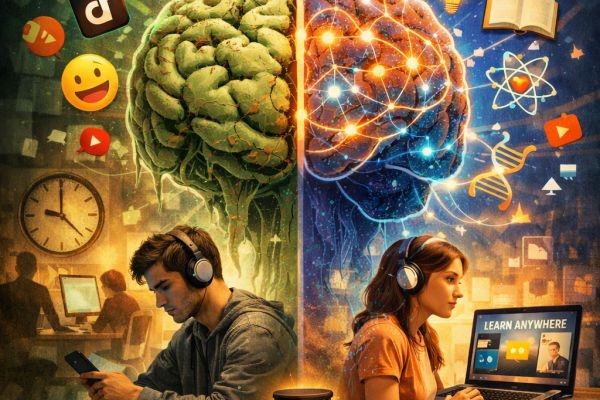
Brain Rot or Brain Growth? How Short-Form Content Is Rewiring Our Minds
Imagine this.
You unlock your phone to reply to one message.
Ten minutes later, you've watched:
- A cooking hack
- A comedy sketch
- A football highlight
- A cat dancing
- A finance tip
- A motivational speech
- Three memes
- Two AI videos
…and you still haven't replied to that message.
Sound familiar?
Welcome to the era of short-form content, where videos lasting just 10–60 seconds dominate our screens and compete relentlessly for our attention.
Platforms like TikTok, Instagram Reels, YouTube Shorts, and Snapchat Spotlight have transformed how we consume information. While some experts warn about "brain rot" and shrinking attention spans, others argue these bite-sized videos are making learning faster and more accessible than ever.
So, is short-form content destroying our brains—or simply rewiring them for a new digital age?
Let's explore the science.
What Is "Brain Rot"?
The term brain rot has exploded across social media. While it's not a medical diagnosis, it describes the feeling that excessive, low-quality digital consumption leaves people mentally exhausted, distracted, and unable to focus deeply.
Many people experience symptoms like:
- Constantly switching between apps
- Difficulty reading long articles
- Losing concentration after a few minutes
- Feeling restless without checking notifications
- Watching videos automatically without remembering them later
It's less about intelligence and more about how our attention is being trained.
Why Short Videos Feel So Addictive
Our brains are wired to seek novelty.
Every swipe on TikTok or Instagram offers something completely different:
- A joke
- Breaking news
- A recipe
- A travel vlog
- A life hack
Because you never know what comes next, your brain keeps expecting another rewarding surprise.
This unpredictability encourages you to keep scrolling, making it easy to spend far more time on these platforms than intended.
Our Attention Spans Are Changing
Many people believe humans now have shorter attention spans than ever before.
The reality is more nuanced.
We haven't necessarily become incapable of paying attention—we've become accustomed to rapidly changing information.
Think about how you consume content today:
- News summaries instead of newspapers
- Reels instead of documentaries
- AI-generated summaries instead of full reports
- Podcasts at 1.5x speed
Our brains are adapting to speed.
That adaptation is helpful in some situations—but it can make slower, more demanding tasks feel harder.
The Good Side of Short-Form Content
Short-form content isn't inherently harmful.
In fact, it has changed education in remarkable ways.
Today, you can learn:
- Coding basics
- Photography tricks
- Financial literacy
- Cooking recipes
- Language vocabulary
- Fitness techniques
- Science facts
—all within a minute.
Complex ideas are now accessible to millions who might never read a textbook on the subject.
Learning has become faster, more visual, and available almost anywhere.
Information Travels Faster Than Ever
One major advantage of short-form videos is speed.
Important developments can spread across the world in minutes.
Educational creators simplify complicated topics into digestible clips, helping viewers understand concepts that once required hours of study.
For busy professionals and students, this format fits naturally into daily life.
Instead of waiting for free time, people learn while commuting, standing in line, or taking short breaks.
The Downside: Surface-Level Knowledge
There's a catch.
Watching a 30-second explanation doesn't always mean you've mastered the topic.
Many viewers mistake familiarity for understanding.
You might recognize:
- AI terminology
- Economic trends
- Psychology concepts
- Nutrition advice
…but struggle to explain them in depth.
Short-form content is excellent for discovery—but often insufficient for deep expertise.
Real learning still requires reading, practicing, and thinking critically.
Multitasking Is Becoming the Default
Today's average viewer often:
- Watches a Reel
- Replies to texts
- Listens to music
- Eats lunch
- Scrolls comments
—all at the same time.
Although this feels productive, constantly dividing attention can make it harder to fully absorb information or remember details later.
Sometimes, doing one thing well is more effective than doing five things halfway.
Why Our Brains Love Instant Gratification
Short videos provide immediate entertainment.
Unlike books or long documentaries, there's no waiting.
Every few seconds brings:
- A laugh
- A surprise
- A new fact
- A dramatic twist
Over time, this can make slower activities—like reading a novel or studying for an exam—feel less stimulating, not because they're less valuable, but because they reward patience instead of instant excitement.
The Rise of "Micro-Learning"
One of the biggest educational trends in 2026 is micro-learning.
Instead of studying for two hours straight, learners consume:
- Five-minute lessons
- One-minute tutorials
- Interactive quizzes
- Visual explainers
This approach works particularly well for:
- Language learning
- Productivity tips
- Software tutorials
- Revision before exams
When paired with deeper study, micro-learning can significantly improve retention and motivation.
Why Creators Are Thinking Differently
Content creators now compete for attention in the first few seconds.
That has changed storytelling itself.
Successful creators often:
- Start with a bold question
- Reveal the ending first
- Use rapid editing
- Add subtitles
- Keep transitions fast
- Eliminate pauses
This style influences not only entertainment but also education, journalism, and marketing.
Is Creativity Actually Improving?
Surprisingly, yes.
Short-form platforms have lowered the barrier to content creation.
People are producing:
- Mini documentaries
- Educational animations
- Comedy sketches
- Business insights
- Science explainers
- Cinematic travel videos
Creators now communicate ideas more efficiently than ever.
The challenge isn't a lack of creativity—it's capturing attention in an increasingly crowded digital space.
The Mental Health Debate
Not all effects are positive.
Endless scrolling can contribute to:
- Comparison with others
- Fear of missing out (FOMO)
- Information overload
- Reduced sleep quality
- Digital fatigue
Many users report feeling mentally drained after long scrolling sessions, even if they enjoyed the content.
Being intentional about screen time can help reduce these effects.
How to Consume Short-Form Content Smarter
You don't need to quit social media.
Instead, build healthier habits:
- Set daily screen-time limits.
- Follow creators who educate and inspire.
- Save useful videos instead of endlessly scrolling.
- Balance quick videos with books, podcasts, or long-form articles.
- Turn off unnecessary notifications.
- Schedule phone-free time during meals or before bed.
Technology works best when you control it—not the other way around.
What the Future Looks Like
Short-form content isn't disappearing anytime soon.
In fact, it's likely to become even more personalized through AI, delivering videos tailored to your interests, habits, and learning style.
We may soon see:
- AI-generated personalized lessons
- Interactive educational Shorts
- Instant language translation
- Real-time learning recommendations
- Mixed reality micro-content
The challenge will be using these tools to expand knowledge rather than simply consume endless entertainment.
So... Brain Rot or Brain Growth?
The answer isn't black and white.
Short-form content is a tool.
Like any powerful tool, its impact depends on how we use it.
If every spare moment is spent mindlessly scrolling, it can encourage distraction, reduce patience, and replace deeper thinking.
But when used intentionally, it can:
- Spark curiosity
- Teach valuable skills
- Introduce new ideas
- Inspire creativity
- Make education more accessible
The goal isn't to avoid short-form content—it's to balance it with activities that require reflection, focus, and sustained attention.
Final Thoughts
The digital world has fundamentally changed how we consume information. Our brains are adapting to a faster, more visual, and highly interactive environment where ideas can travel across the globe in seconds.
Rather than asking whether short-form content is "good" or "bad," a better question is:
Are we using it consciously?
The future belongs to people who can do both—quickly absorb useful information and dive deeply into complex ideas when it matters.
In a world built on endless scrolling, the real superpower may not be consuming more content—it may be knowing when to stop scrolling and start thinking.