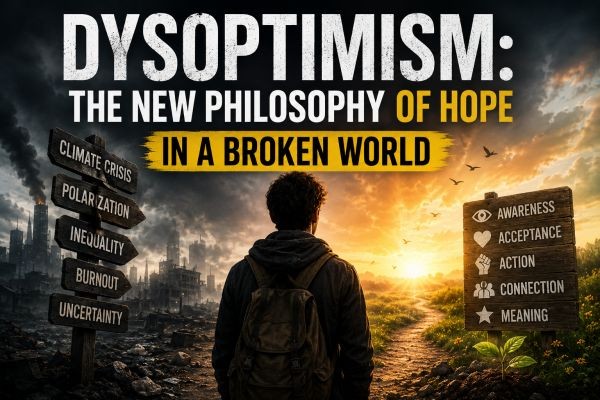
Dysoptimism: The New Philosophy of Hope in a Broken World
What If Hope Doesn't Require Optimism?
For generations, society has sold us a simple formula:
"Stay positive."
"Everything happens for a reason."
"Things will work out."
But what happens when the world around us seems determined to prove otherwise?
Wars continue. Climate disasters intensify. Artificial intelligence disrupts careers. Mental health struggles rise. Trust in institutions declines. Every day, headlines remind us that uncertainty isn't the exception anymore—it's the norm.
And yet, despite all this, millions of people continue moving forward.
Not because they're optimistic.
Because they've become something else.
Welcome to the philosophy of Dysoptimism.
What Is Dysoptimism?
Dysoptimism is the belief that the future may not necessarily get better, yet life remains worth engaging with.
Unlike traditional optimism, which assumes positive outcomes, dysoptimism accepts the possibility of failure, disappointment, and chaos while still choosing action, meaning, and hope.
In simple words:
Dysoptimists don't believe everything will be okay.
They believe they can keep going even if it isn't.
It is hope without illusion.
Courage without guarantees.
Meaning without certainty.
Why Traditional Optimism Is Losing Its Appeal
For much of modern history, optimism was easy to sell.
Economic growth seemed endless.
Technology promised progress.
Each generation expected life to improve.
Today, however, many people feel differently.
Young adults entering the workforce face rising costs, unstable careers, housing crises, and an overwhelming digital world.
When reality repeatedly contradicts positive expectations, forced optimism begins to feel dishonest.
People start asking:
-
What if things don't improve?
-
What if success isn't guaranteed?
-
What if the future remains uncertain forever?
Dysoptimism emerges from these questions.
Not as despair.
But as a more realistic form of hope.
The Difference Between Pessimism, Optimism, and Dysoptimism
| Philosophy | Core Belief |
|---|---|
| Optimism | Things will probably get better. |
| Pessimism | Things will probably get worse. |
| Dysoptimism | Things may get worse, but I will still find meaning and keep moving. |
Optimists trust outcomes.
Pessimists expect failure.
Dysoptimists focus on response.
Their mindset is:
"I cannot control the future. I can control how I face it."
The Rise of Dysoptimism in Generation Z
Generation Z grew up during a unique period of history.
Many experienced:
-
Global pandemics
-
Economic instability
-
Social media pressure
-
Political polarization
-
Rapid technological disruption
-
Climate anxiety
As a result, blind optimism often feels disconnected from reality.
Interestingly, younger generations are not necessarily becoming more pessimistic.
They're becoming more adaptive.
Instead of believing in guaranteed success, they prioritize:
-
Mental resilience
-
Personal growth
-
Authenticity
-
Emotional awareness
-
Flexible life paths
This shift reflects dysoptimistic thinking.
They are preparing for uncertainty rather than denying it.
The Ancient Roots of Dysoptimism
Although the term feels modern, the idea itself is ancient.
Many philosophical traditions explored similar concepts.
Stoicism
The Stoics encouraged people to focus only on what they could control.
They accepted suffering as part of life rather than something to avoid at all costs.
Philosopher Marcus Aurelius wrote extensively about embracing uncertainty while acting with integrity.
Buddhism
Buddhist teachings begin by acknowledging suffering.
Rather than promising perfect happiness, they teach acceptance, awareness, and compassion.
Existentialism
Thinkers like Albert Camus argued that life may have no predetermined meaning.
Yet humans can still create meaning through choices and actions.
Dysoptimism combines elements from all three traditions.
Why Hope Is Stronger When It Doesn't Depend on Results
Imagine two people climbing a mountain.
The first climbs because they are certain they will reach the summit.
The second climbs because the journey itself matters.
If a storm forces both to stop halfway, who remains stronger?
The second person.
Because their purpose was never dependent on success.
Dysoptimism shifts hope from outcomes to values.
Instead of asking:
"Will everything work out?"
It asks:
"What kind of person do I want to be regardless of what happens?"
This subtle shift changes everything.
The Internet Age and the Death of Certainty
The internet gives us access to more information than any generation before us.
Ironically, it also exposes us to endless uncertainty.
Every day we see:
-
Economic predictions
-
AI warnings
-
Environmental concerns
-
Political conflicts
-
Personal success stories
The result?
A constant awareness that life is unpredictable.
Older philosophies often assumed stability.
Modern life rarely offers it.
Dysoptimism acknowledges this reality instead of fighting it.
It accepts that certainty may never return.
And that's okay.
The Hidden Freedom of Dysoptimism
At first glance, dysoptimism sounds depressing.
But many people find it surprisingly liberating.
Why?
Because it removes impossible expectations.
You no longer need to:
-
Pretend everything is fine
-
Force positivity
-
Predict the future
-
Guarantee success
Instead, you focus on what matters now.
Your effort.
Your relationships.
Your values.
Your growth.
The future becomes less of a burden and more of an adventure.
Living as a Dysoptimist
Practicing dysoptimism doesn't mean giving up.
It means engaging with life honestly.
A dysoptimist:
Accepts uncertainty
They stop demanding guarantees before taking action.
Chooses meaningful work
Even if success isn't certain.
Builds relationships deeply
Even knowing people may eventually leave.
Pursues dreams realistically
Without depending on perfect outcomes.
Finds purpose in effort
Rather than results alone.
This mindset creates emotional resilience because it doesn't collapse when reality becomes difficult.
The Paradox of Modern Hope
Here's the strange truth:
Many of the strongest people today are not optimistic.
They are dysoptimistic.
They understand the world's problems.
They recognize uncertainty.
They see potential failures.
Yet they continue creating, loving, building, learning, and dreaming.
Not because they believe success is guaranteed.
But because they believe life remains meaningful regardless.
And perhaps that is a deeper form of hope.
Final Thoughts: Hope After Certainty
Every era develops its own philosophy.
The Industrial Age celebrated progress.
The Information Age celebrated knowledge.
The age of uncertainty may celebrate resilience.
Dysoptimism represents a growing cultural shift.
A recognition that life doesn't owe us happy endings.
But also a belief that meaning doesn't require them.
Perhaps the future will be difficult.
Perhaps it will surprise us.
Perhaps it will be both.
A dysoptimist doesn't need to know.
They simply choose to move forward anyway.
And in a world obsessed with certainty, that quiet courage may become the most important philosophy of all.