
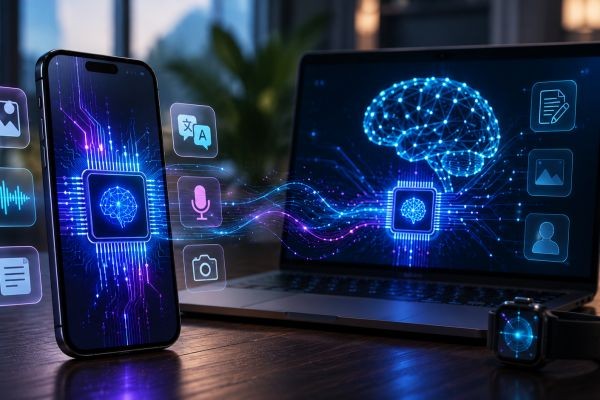
Inside the Rise of On-Device AI: Privacy Meets Power
Artificial intelligence has become a part of everyday life. We use it to write emails, edit photos, translate languages, summarize documents, and even generate code. But until recently, almost every AI request relied on one thing: the cloud.
When you asked an AI assistant a question, your data traveled to distant servers, where powerful computers processed the request before sending the result back. While effective, this approach raised concerns about privacy, internet dependency, latency, and energy consumption.
In 2026, a major shift is underway.
Instead of sending everything to the cloud, many AI tasks are now happening directly on your device. Whether it's a smartphone, laptop, tablet, or wearable, modern hardware has become powerful enough to run advanced AI models locally.
This new approach is known as On-Device AI, and it's redefining how artificial intelligence balances performance with privacy.
What Is On-Device AI?
On-Device AI refers to artificial intelligence models that run directly on your personal device rather than relying on remote cloud servers.
Instead of transmitting your data over the internet for processing, the AI performs computations locally using specialized hardware such as:
- Neural Processing Units (NPUs)
- AI accelerators
- Graphics Processing Units (GPUs)
- Advanced mobile chipsets
The result is faster responses, greater privacy, and improved reliability.
Think of it as having a powerful AI assistant living inside your device instead of somewhere on the internet.
How Traditional Cloud AI Works
For years, the AI workflow looked like this:
- You enter a request.
- Your data is sent to cloud servers.
- Large AI models process the information.
- The results are returned to your device.
This system works well but has several limitations:
- Requires an internet connection
- Can introduce delays
- Consumes bandwidth
- Raises privacy concerns
- Depends on remote servers being available
How On-Device AI Is Different
With On-Device AI, the workflow changes dramatically.
- You make a request.
- The AI processes it locally.
- Results appear almost instantly.
No unnecessary data leaves your device for many everyday tasks.
This creates a faster and more secure user experience.
Why On-Device AI Is Becoming So Popular
Several technological advances have made this possible.
1. More Powerful AI Chips
Modern processors now include dedicated AI hardware capable of performing trillions of operations every second.
These specialized chips are optimized for machine learning tasks while using minimal power.
This allows smartphones and laptops to run increasingly sophisticated AI models.
2. Smaller AI Models
Earlier AI models were enormous and required powerful data centers.
Today, engineers have developed smaller, more efficient models that deliver impressive performance while fitting on consumer devices.
These compact models make local AI practical without sacrificing too much capability.
3. Faster Response Times
Because processing happens locally, there is no need to wait for data to travel across the internet.
Tasks such as:
- Voice recognition
- Image editing
- Text summarization
- Language translation
can happen almost instantly.
4. Better Battery Efficiency
Dedicated AI hardware is designed specifically for machine learning workloads.
Instead of using the main processor inefficiently, specialized AI chips complete tasks faster while consuming less energy.
Privacy: The Biggest Advantage
Privacy has become one of the strongest reasons for adopting On-Device AI.
When processing remains on your device:
- Personal photos stay local.
- Voice recordings don't need to be uploaded.
- Sensitive documents remain private.
- Conversations are less likely to leave your device.
- Personal habits are better protected.
This significantly reduces exposure to data breaches and unauthorized access.
For users who value confidentiality, local AI offers a major improvement over cloud-only solutions.
AI That Works Even Without Internet
One of the most practical benefits is offline functionality.
Imagine being on an airplane or in a remote location without reliable internet access.
With On-Device AI, many features can still work, including:
- Live translation
- Voice typing
- Smart photo editing
- Document summarization
- Writing assistance
- Image recognition
This makes AI more dependable wherever you are.
Real-World Applications of On-Device AI
The technology is already transforming everyday devices.
Smartphones
Modern phones use On-Device AI for:
- Face recognition
- Camera enhancements
- Live captions
- Noise cancellation
- Photo organization
- Writing suggestions
- Language translation
These tasks happen in real time without requiring constant cloud access.
AI PCs and Laptops
The new generation of AI-powered computers uses local intelligence for:
- Meeting summaries
- Background noise removal
- Image generation
- Code completion
- Productivity assistance
- Battery optimization
Developers, designers, and professionals benefit from faster workflows while keeping sensitive work local.
Wearables
Smartwatches and fitness devices increasingly process health data directly on the device.
Examples include:
- Sleep tracking
- Heart-rate analysis
- Workout detection
- Fall detection
- Health alerts
Local processing helps protect highly personal health information.
Smart Home Devices
Instead of sending every voice command to cloud servers, future smart home devices will increasingly process commands locally.
This improves both response speed and user privacy.
On-Device AI vs Cloud AI
| Feature | On-Device AI | Cloud AI |
|---|---|---|
| Internet Required | Usually No | Yes |
| Privacy | Very High | Moderate |
| Speed | Instant | Depends on Network |
| Latency | Very Low | Higher |
| Large Model Capability | Limited | Excellent |
| Battery Usage | Optimized | Depends on Connectivity |
| Offline Support | Yes | No |
Challenges of On-Device AI
Despite its benefits, On-Device AI isn't perfect.
Limited Computing Resources
Smartphones cannot yet match the computational power of massive cloud data centers.
Some highly complex AI tasks still require cloud processing.
Storage Requirements
AI models occupy valuable storage space.
As models become more capable, balancing performance with device storage remains a challenge.
Heat Management
Running advanced AI continuously generates heat.
Manufacturers must carefully optimize hardware to maintain performance without overheating.
Model Updates
Cloud AI models can be updated instantly.
On-device models often require software updates before users receive major improvements.
The Best of Both Worlds: Hybrid AI
Many companies are now adopting a hybrid approach.
Simple and sensitive tasks run locally.
More demanding requests are securely handed off to the cloud.
For example:
- Correcting grammar → Local AI
- Organizing photos → Local AI
- Writing long research papers → Cloud AI
- Generating high-resolution videos → Cloud AI
This combination provides both privacy and advanced capabilities.
Why Businesses Are Investing in On-Device AI
Technology companies see several long-term advantages.
Lower Cloud Costs
Processing requests locally reduces server expenses.
Better Customer Trust
Consumers increasingly prefer products that protect their personal information.
Privacy has become a competitive advantage.
Improved Reliability
Services remain available even during network interruptions.
Faster User Experience
Instant AI responses create smoother interactions and higher customer satisfaction.
Industries Being Transformed
On-Device AI is expected to reshape numerous industries, including:
- Consumer electronics
- Healthcare
- Automotive
- Manufacturing
- Retail
- Education
- Financial services
- Smart homes
- Robotics
- Industrial automation
As AI chips become more powerful, local intelligence will become standard across many connected devices.
What the Future Looks Like
Over the next few years, On-Device AI is expected to become the default experience for everyday computing. Future smartphones, laptops, smart glasses, and wearable devices will likely include even more powerful AI processors capable of handling increasingly sophisticated tasks without relying heavily on the cloud.
Rather than choosing between cloud AI and local AI, users will benefit from intelligent systems that automatically decide where processing should occur. Routine, privacy-sensitive tasks will stay on the device, while highly complex requests can seamlessly use secure cloud resources when needed.
This hybrid approach promises faster performance, stronger privacy, and a more personalized AI experience.
Final Thoughts
The rise of On-Device AI represents one of the most important advancements in artificial intelligence in 2026. It shifts AI from being something that primarily lives in distant data centers to something that works directly within the devices we use every day.
By processing information locally, On-Device AI delivers faster responses, greater privacy, offline functionality, and improved energy efficiency. At the same time, it reduces dependence on cloud infrastructure while giving users more control over their personal data.
Although cloud-based AI will continue to play a vital role for large-scale and computationally intensive tasks, the future is increasingly moving toward a hybrid model where privacy and performance coexist. As AI hardware continues to evolve, the devices in our pockets and on our desks will become smarter, more capable, and more trustworthy than ever before.
In the years ahead, the question won't be whether your device uses AI—it will be how much of that intelligence happens right in your hands.
Frequently Asked Questions (FAQs)
1. What is On-Device AI?
On-Device AI refers to artificial intelligence that runs directly on a smartphone, laptop, tablet, or other device instead of relying on cloud servers for processing.
2. Why is On-Device AI more private?
Since data is processed locally, sensitive information such as photos, voice recordings, and documents often doesn't need to leave your device, reducing privacy risks.
3. Can On-Device AI work without the internet?
Yes. Many On-Device AI features, including voice recognition, translation, photo editing, and writing assistance, can function offline.
4. Will On-Device AI replace cloud AI?
Not completely. The future is expected to be hybrid, with local AI handling everyday tasks and cloud AI supporting more complex or resource-intensive operations.