
Does Psychology Create the People It Describes?
Imagine being told your entire life that you're shy.
At first, you might disagree.
You enjoy conversations. You have opinions. You like meeting people.
But after hearing the label repeatedly from parents, teachers, friends, and even personality tests—you slowly begin acting differently.
You speak less.
You avoid social situations.
You start introducing yourself as "an introvert."
Years later, the label feels like a fact.
But here's the unsettling question:
Were you always that person?
Or did the label help create the person you became?
This idea sits at the heart of one of the most intriguing modern psychological concepts: Looping Effects Theory.
Unlike traditional theories that try to explain human behavior, Looping Effects Theory suggests something much deeper:
The act of describing people can actually change them.
And if that's true, psychology may not simply study human behavior—it may actively shape it.
What Is Looping Effects Theory?
Looping Effects Theory was developed by philosopher and historian of science Ian Hacking.
The theory proposes that when society creates categories to describe people, those categories don't remain neutral.
People become aware of those labels.
They react to them.
They adapt to them.
And over time, the category itself begins to change because the people inside it have changed.
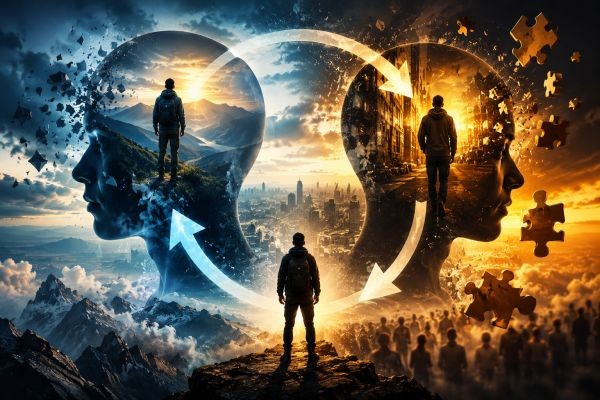
This creates a continuous feedback loop.
Psychologists study people.
People learn what psychologists say about them.
People change their behavior.
Psychologists observe the new behavior.
The category evolves.
And the cycle begins again.
This is why it's called a looping effect.
The Difference Between Describing and Creating
For centuries, science worked under a simple assumption:
A scientist observes reality and describes what already exists.
For example:
A biologist discovers a new species.
A physicist discovers a new law of nature.
The discovery doesn't change the thing being studied.
Gravity doesn't behave differently because someone wrote a book about it.
But humans are different.
Humans can read.
Humans can reflect.
Humans can change their behavior based on information about themselves.
That's where Looping Effects Theory becomes revolutionary.
The moment a psychological category enters public awareness, it can begin influencing the people it describes.
The Introvert Example Everyone Understands
Let's revisit the introvert example.
A teenager takes an online personality test.
The result says:
"You are an introvert."
Initially, this may simply feel like an observation.
But over time, the label becomes part of their identity.
They begin explaining their actions through that label.
- "I don't like parties because I'm an introvert."
- "I can't give presentations because I'm an introvert."
- "I prefer staying home because that's just who I am."
Eventually, the label stops describing behavior.
The label starts producing behavior.
The theory asks a provocative question:
Did the personality test discover the person—or help create them?
Social Media Has Supercharged Looping Effects
If Looping Effects Theory was powerful before social media, it has become even more powerful today.
Platforms like TikTok, Instagram, and YouTube constantly expose people to psychological labels.
Every day, millions encounter videos claiming:
- Signs you're highly sensitive
- Traits of an empath
- Symptoms of burnout
- Characteristics of gifted people
- Hidden signs of ADHD
- Indicators you're emotionally unavailable
Many of these categories contain useful insights.
But they also create new identities.
People begin viewing themselves through these frameworks.
The more they identify with the category, the more likely they are to behave according to it.
Social media has transformed psychological labels into personal brands.
When Diagnoses Change Identity
One of the most controversial aspects of Looping Effects Theory involves mental health diagnoses.
Receiving a diagnosis can be incredibly helpful.
It can provide clarity, treatment options, support systems, and self-understanding.
However, diagnoses can also influence self-perception.
A person who receives a diagnosis may begin organizing their entire identity around it.
Their understanding of themselves changes.
Their relationships change.
Their expectations change.
Sometimes even their future decisions change.
The diagnosis doesn't merely explain experiences.
It becomes part of the experience itself.
This isn't necessarily good or bad.
It's simply an example of the looping effect in action.
The Hidden Power of Labels
Think about the labels society uses every day:
- Smart
- Gifted
- Average
- Successful
- Attractive
- Introverted
- Extroverted
- Talented
- Difficult
- Lazy
Most people assume these are harmless descriptions.
But psychological research repeatedly shows that expectations influence behavior.
Students labeled as "gifted" often perform better.
Employees labeled as "high potential" frequently gain more confidence.
Children repeatedly called "problematic" may eventually internalize that identity.
The label changes how others treat the individual.
The treatment changes behavior.
The behavior reinforces the label.
Another loop is born.
Are We Living Inside Psychological Scripts?
One of the most fascinating implications of Looping Effects Theory is that many people may unknowingly live according to psychological scripts.
A script is a story we tell ourselves about who we are.
Examples include:
- "I'm the responsible one."
- "I'm bad at relationships."
- "I'm naturally unlucky."
- "I'm not creative."
- "I'm the smart friend."
These stories influence choices, habits, and expectations.
Over time, people begin collecting evidence that supports the script while ignoring evidence that challenges it.
The script becomes reality.
Not because it was true at the beginning.
But because behavior gradually made it true.
The TikTok Generation and Identity Inflation
Never before have people had access to so many identity categories.
A teenager today can discover dozens of personality frameworks within a single afternoon.
While self-discovery can be valuable, there is a risk.
People may begin searching for labels instead of experiences.
Rather than asking:
"Who am I becoming?"
They ask:
"Which category do I belong to?"
Looping Effects Theory warns us that categories are powerful.
They don't simply organize reality.
They participate in creating reality.
Most Important Question of All
Perhaps the biggest lesson from Looping Effects Theory is this:
Not every label deserves permanent residence in your identity.
Some labels help.
Some labels limit.
The challenge is learning the difference.
Whenever someone describes you—or whenever you describe yourself—pause and ask:
Is this label explaining my behavior?
Or
Is this label shaping my behavior?
That single question may reveal more about your identity than any personality test ever could.
Final Thoughts
Looping Effects Theory challenges one of our deepest assumptions about psychology.
We often believe that psychological categories simply reveal who we are.
But what if they do more than reveal?
What if they influence?
What if they guide?
What if they create?
In a world filled with personality tests, social media identities, self-help frameworks, and psychological labels, this theory offers a powerful reminder:
The stories we tell about ourselves can become the people we become.
And that means identity is not always something we discover.
Sometimes, it's something we continuously create.
SEO FAQs
What is Looping Effects Theory in psychology?
Looping Effects Theory suggests that psychological categories and labels can influence the behavior of the people they describe, creating a feedback loop between description and reality.
Who developed Looping Effects Theory?
The theory was proposed by philosopher and historian of science Ian Hacking.
Why is Looping Effects Theory important today?
The theory is especially relevant in the age of social media, where personality labels, diagnoses, and identity categories spread rapidly and influence how people see themselves.
Can labels change behavior?
Yes. Research suggests that labels and expectations can influence self-perception, decision-making, confidence, and behavior over time.
What is an example of a looping effect?
A person repeatedly labeled as an introvert may gradually adopt behaviors associated with introversion, reinforcing the original label.