
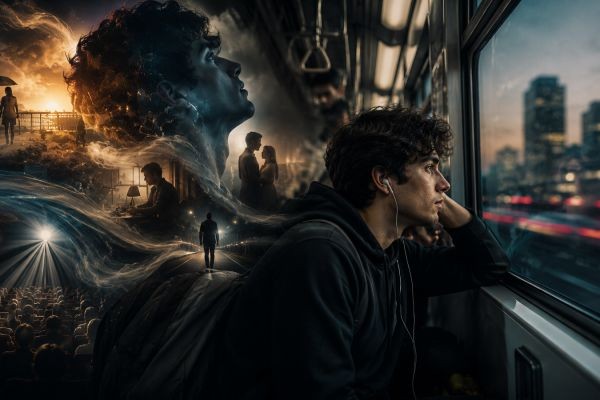
Why Everyone Thinks They’re The Main Character
Somewhere between midnight overthinking, aesthetic Instagram stories, silent metro rides, and pretending life has background music…
an entire generation started seeing life like a movie.
Not consciously.
Not dramatically.
But subtly.
You walk alone with earphones on and suddenly the world feels cinematic.
Rain feels symbolic.
Eye contact feels like destiny.
Pain feels poetic.
And heartbreak starts looking less like suffering and more like “character development.”
Welcome to the age of Main Character Syndrome.
A strange psychological phenomenon where people unconsciously begin treating themselves as the protagonist of reality.
At first, it sounds narcissistic.
But honestly?
It’s much deeper than that.
Because this generation didn’t create Main Character Syndrome out of ego alone.
It created it out of emotional survival.
What Actually Is Main Character Syndrome?
Main Character Syndrome is not an official mental disorder.
It’s more like a modern psychological and philosophical pattern shaped by social media, loneliness, self-awareness, internet culture, and emotional storytelling.
The idea is simple:
People start viewing their lives as if they are the central character in a film.
That explains why humans:
-
imagine dramatic conversations in advance
-
replay emotional moments repeatedly
-
create imaginary scenarios while listening to music
-
romanticize sadness
-
think strangers are observing them constantly
-
turn random coincidences into “signs from the universe”
And strangely…
almost everyone does this to some extent.
The Real Reason Humans Think Like This
Because humans are storytelling creatures.
The brain naturally creates narratives to make life feel meaningful.
Without stories, suffering feels pointless.
Without emotional meaning, routines become unbearable.
So the mind starts building cinematic interpretations around ordinary life.
That awkward silence?
Now it feels emotionally symbolic.
That breakup?
Now it becomes “the phase that changed me.”
That lonely train ride?
Suddenly it feels like the opening scene of a coming-of-age film.
Maybe this sounds dramatic.
But psychologically, it makes sense.
Humans don’t just live life.
They narrate it internally.
Social Media Turned Everyone Into A Performer
Before social media, most people simply experienced moments.
Now people also visualize how those moments look externally.
Coffee is not just coffee anymore.
It’s an aesthetic frame.
Travel isn’t just travel.
It’s content.
Even sadness gets edited now.
A crying selfie with soft music in the background somehow transforms pain into performance.
And slowly, people stop asking:
“What am I feeling?”
Instead they ask:
“How does this moment look?”
That shift changed human psychology more than we realize.
The Dangerous Side Of Romanticizing Your Own Life
Main Character Syndrome feels comforting sometimes.
It makes ordinary life feel meaningful.
It gives emotional weight to existence.
But there’s also a darker side.
Because when people become too attached to their own internal movie…
they forget other people are protagonists too.
Everyone becomes:
-
side characters
-
plot devices
-
temporary lessons
-
emotional entertainment
That’s why modern relationships often feel emotionally disconnected.
People want experiences more than commitment.
Aesthetic chemistry more than emotional responsibility.
Intensity more than stability.
Sometimes people don’t even fall in love with a person.
They fall in love with the feeling of being the main character around them.
Philosophy Already Predicted This
Long before TikTok edits and cinematic reels existed, philosophers already understood that humans see reality through themselves.
Existentialist philosophers believed humans constantly search for meaning in a meaningless world.
Psychology explains that humans naturally create self-centered perspectives because consciousness itself is experienced individually.
You never truly experience reality objectively.
You experience your version of reality.
That means:
everyone is technically the “main character” from their own perspective.
And maybe that realization is both beautiful and terrifying.
Because every stranger you ignore…
every random person sitting silently in a café…
every exhausted employee walking home…
has an inner world as emotionally detailed as yours.
Why Loneliness Makes Main Character Syndrome Stronger
The lonelier people become, the more cinematic their inner worlds grow.
Because imagination fills emotional emptiness.
That’s why:
-
lonely people daydream more
-
isolated people romanticize life more deeply
-
emotionally neglected people create fantasy narratives internally
Sometimes Main Character Syndrome isn’t attention-seeking.
Sometimes it’s self-soothing.
A way to make life feel emotionally alive.
Music Is Fueling This Entire Phenomenon
Think about how often music changes perception.
A normal walk becomes emotional with the right song.
Late-night city lights suddenly feel meaningful.
Heartbreak feels visually beautiful instead of ugly.
Music edits emotions into scenes.
That’s why humans attach memories to songs so intensely.
A song doesn’t just remind you of a person.
It revives an entire emotional era.
Maybe Everyone Is The Main Character
And honestly…
maybe that’s not entirely wrong.
Maybe every human really is living inside a deeply personal psychological movie.
The problem only begins when people forget:
their story is not the only one happening.
Empathy begins the moment you realize:
every person you meet has fears, dreams, memories, insecurities, and silent battles as complex as yours.
The girl laughing loudly with friends may be emotionally exhausted.
The confident boy posting gym photos may secretly hate himself.
The quiet stranger in the metro may be fighting thoughts nobody can see.
Everyone is carrying invisible narratives.
Final Thoughts
Main Character Syndrome is not just an internet joke.
It’s a reflection of modern loneliness, self-awareness, emotional storytelling, and the human need to feel significant in an overwhelming world.
Maybe humans were always like this.
Social media simply exposed it.
Because deep down, everyone wants to believe:
their pain matters,
their story means something,
and someday all the confusion will make sense like the ending of a film.
And maybe that desire itself…
is one of the most human things ever.