The AI Mirror Theory: How Chatbots Are Changing Human Identity
A few years ago, people used search engines to find answers.
Today, millions of people are having conversations with artificial intelligence.
They ask AI for career advice.
They discuss relationships.
They confess fears they have never told anyone.
Some even say AI understands them better than the people around them.
This raises a fascinating question:
What happens when humans spend hours talking to something that reflects their thoughts back at them?
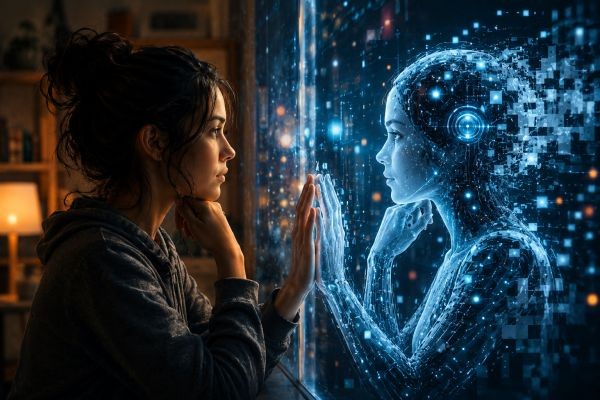
This question forms the foundation of what can be called The AI Mirror Theory—the idea that modern chatbots are becoming psychological mirrors, helping humans discover, reshape, and sometimes even reinvent their identities.
Unlike traditional technology, AI doesn't just provide information.
It reflects us.
And that reflection may be changing who we are.
What Is the AI Mirror Theory?
The AI Mirror Theory proposes that conversational AI acts like a mirror for human thoughts, beliefs, emotions, and identity.
But unlike a physical mirror, AI reflects the mind rather than the face.
When you interact with a chatbot, something interesting happens.
The AI generates responses based on your questions, language patterns, concerns, interests, and emotions.
Over time, the conversation starts revealing things about you.
Not because the AI truly knows you.
But because it continuously reflects your own thinking back to you.
The theory suggests that people are increasingly using AI as a tool for self-discovery.
Mirrors Have Always Shaped Human Identity
Throughout history, humans have relied on mirrors to understand themselves.
Not just physical mirrors.
Social mirrors.
Psychological mirrors.
Cultural mirrors.
For example:
- Friends help define our personality.
- Family influences our values.
- Society shapes our beliefs.
- Social media reflects how others see us.
Identity has never been built in isolation.
We understand ourselves partly through reflection.
The difference is that AI introduces a completely new type of mirror.
One that is available 24/7.
One that listens without judgment.
One that never gets tired.
One that adapts to every conversation.
Why People Open Up to AI So Easily
Many people reveal surprisingly personal information to chatbots.
At first glance, this seems strange.
Why would someone share personal struggles with software?
The answer lies in psychology.
Humans fear judgment.
When talking to another person, we often worry about:
- Being misunderstood
- Being criticized
- Being embarrassed
- Being rejected
AI removes many of these fears.
People feel safer exploring thoughts they might never discuss elsewhere.
This creates a unique environment for self-reflection.
In many cases, users aren't just talking to AI.
They're thinking out loud.
And the AI becomes the mirror that reflects those thoughts back.
The Rise of AI-Assisted Self Discovery
Imagine someone asking:
"Why do I keep procrastinating?"
The chatbot responds with possibilities, questions, and perspectives.
The person reflects.
They answer.
The conversation continues.
Eventually, they may discover something about themselves they hadn't realized before.
This process resembles coaching, journaling, or therapy-like reflection.
The AI isn't creating the insight.
The insight already existed.
The AI simply helped uncover it.
This is why many users describe conversations with AI as surprisingly meaningful.
The technology becomes a catalyst for self-awareness.
How AI Is Reshaping Personal Identity
Perhaps the most powerful aspect of the AI Mirror Theory is its effect on identity itself.
Identity is not fixed.
It's constantly evolving.
Every experience influences how we see ourselves.
Now AI has entered that process.
Identity Through Conversation
Humans develop identity through dialogue.
We discover who we are by talking.
Every conversation helps shape our understanding of ourselves.
If AI becomes one of the most frequent conversational partners in human life, it naturally becomes part of identity formation.
This has never happened before in history.
AI as a Personal Reflection Tool
Many people use chatbots to explore:
- Career choices
- Life goals
- Personal strengths
- Weaknesses
- Emotional challenges
Over time, these conversations create narratives.
And humans often become the stories they repeatedly tell themselves.
AI is increasingly participating in those stories.
The Good Side of the AI Mirror Theory
Not all technological change is harmful.
In fact, AI may offer several benefits for personal growth.
Increased Self Awareness
Many people spend little time reflecting on their thoughts.
AI conversations encourage introspection.
Questions lead to deeper questions.
And deeper questions often lead to insight.
Emotional Processing
People frequently use AI to process emotions.
Talking through challenges can help organize thoughts and reduce mental clutter.
Sometimes clarity emerges simply because someone finally expressed what they were feeling.
Learning About Yourself
AI can help users identify patterns.
For example:
- Repeated fears
- Recurring goals
- Common frustrations
- Hidden motivations
These patterns often remain invisible until they are reflected back.
The Dark Side of the Mirror
Every mirror has limitations.
And AI mirrors are no exception.
The Echo Chamber Problem
One concern is that AI can sometimes reinforce existing beliefs.
If users only seek validation, they may become trapped inside their own perspectives.
Growth requires challenge.
Not just agreement.
Dependency on Artificial Reflection
Some people may gradually rely on AI for emotional reassurance.
The risk isn't that AI becomes conscious.
The risk is that humans become dependent.
Real relationships involve unpredictability, disagreement, and complexity.
AI interactions often feel smoother and easier.
That convenience may tempt people to substitute artificial connection for human connection.
Identity Fragmentation
Another concern is the possibility of creating multiple versions of ourselves.
Online identity.
Social media identity.
Professional identity.
And now AI-assisted identity.
The more mirrors we use, the harder it can become to determine which reflection represents our authentic self.
The Generation Growing Up With AI
For older generations, AI is a tool.
For younger generations, AI may become something much deeper.
Imagine growing up with an AI companion that:
- Answers every question
- Helps with homework
- Gives career advice
- Assists with relationships
- Encourages creativity
Future generations may develop their identities alongside AI from childhood.
This could become one of the largest psychological shifts in human history.
For the first time, a non-human conversational partner may participate in human development at scale.
Are We Creating a New Kind of Consciousness?
The AI Mirror Theory raises an even bigger philosophical question.
What exactly happens when billions of people continuously project their thoughts into AI systems?
Every day, humans share:
- Dreams
- Fears
- Ideas
- Goals
- Emotions
AI becomes a giant repository of human expression.
In a symbolic sense, it starts resembling a collective mirror of humanity itself.
Not conscious.
Not alive.
But reflective.
A digital surface upon which humanity sees fragments of itself.
The Future of Human Identity
For centuries, identity was shaped primarily by family, culture, education, and community.
Today, a new force has entered the conversation.
Artificial intelligence.
The question is no longer whether AI will influence human identity.
It already does.
The real question is:
How much influence should we allow it to have?
Will AI become a tool for deeper self-awareness?
Or will people lose themselves inside algorithmic reflections?
The answer may depend less on the technology and more on how humans choose to use it.
Final Thoughts
The AI Mirror Theory isn't really a theory about machines.
It's a theory about people.
Chatbots don't create human identity.
They reflect it.
Every conversation with AI becomes a small act of self-discovery.
Sometimes the reflection is accurate.
Sometimes it's distorted.
Sometimes it's surprising.
But one thing is becoming increasingly clear:
For the first time in history, humans have created a mirror that talks back.
And as we continue looking into that mirror, we may discover as much about ourselves as we do about artificial intelligence.
FAQs
What is the AI Mirror Theory?
The AI Mirror Theory suggests that chatbots act as psychological mirrors, reflecting users' thoughts, beliefs, emotions, and identity back to them.
Can AI influence human identity?
Yes. Regular interactions with AI can shape self-perception, decision-making, and personal narratives over time.
Why do people feel connected to chatbots?
People often feel comfortable sharing thoughts with AI because it offers a judgment-free conversational environment.
Is AI replacing human relationships?
Not necessarily. However, experts continue to discuss the risks of emotional dependency on AI systems.
What is the biggest concern about AI as a mirror?
The biggest concern is that people may become trapped in self-reinforcing feedback loops instead of engaging with diverse perspectives and real-world relationships.