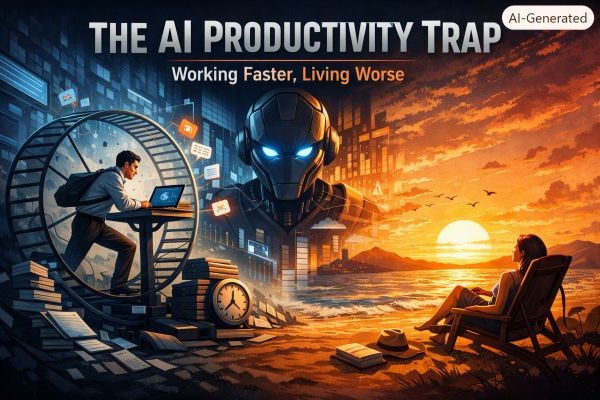
The AI Productivity Trap: Why Working Faster Doesn't Mean Living Better
Every new AI tool promises the same thing:
"Save hours every week."
Write emails in seconds.
Generate presentations instantly.
Summarize meetings automatically.
Code faster.
Design quicker.
Research smarter.
In theory, artificial intelligence should be giving us more free time than ever before.
But here's the strange reality.
People are working longer hours, replying to more messages, attending more meetings, and feeling more exhausted than ever.
If AI is making us more productive…
Why doesn't it feel like we have more time?
Welcome to the AI Productivity Trap—where working faster doesn't necessarily mean living better.
The Promise of AI
When AI tools entered the workplace, the vision was exciting.
Imagine saving two hours every day.
Those extra hours could be spent:
- With family
- Learning new skills
- Exercising
- Traveling
- Reading
- Simply relaxing
The dream wasn't just about efficiency.
It was about creating a better quality of life.
Yet for many professionals, that dream hasn't become reality.
Productivity Has Become an Endless Race
Here's what usually happens.
AI helps you finish a report in 30 minutes instead of two hours.
Great.
Instead of leaving work early, you're assigned:
- Another report
- More meetings
- Additional emails
- New responsibilities
The time you saved doesn't disappear—it gets filled.
This phenomenon is sometimes called productivity creep.
As technology makes us faster, expectations grow just as quickly.
Faster Work Creates Higher Expectations
Think about email.
Years ago, replying within two or three days was acceptable.
Today?
People expect responses within hours.
Sometimes minutes.
AI has accelerated communication so much that "fast" has become the new normal.
Instead of reducing workload, it often raises the standard for everyone.
AI Doesn't Create More Time—It Changes How We Use It
Many professionals assume AI automatically gives them extra time.
In reality, AI changes where time is spent.
Instead of writing documents from scratch, workers now spend more time:
- Reviewing AI-generated content
- Editing outputs
- Fact-checking information
- Managing multiple AI tools
- Learning new workflows
The work evolves rather than disappears.
The Illusion of Being Busy
Modern workplaces often confuse activity with achievement.
You might spend an entire day:
- Prompting AI
- Switching between apps
- Reviewing generated drafts
- Joining video calls
- Answering notifications
At the end of the day, you've been incredibly busy.
But have you accomplished the work that truly matters?
Being productive isn't the same as being constantly occupied.
More Output Doesn't Always Mean Better Work
AI can produce:
- Articles
- Presentations
- Marketing copy
- Code
- Reports
- Designs
—in seconds.
But speed isn't the only measure of quality.
Creative thinking still requires:
- Reflection
- Curiosity
- Experimentation
- Human judgment
Some of history's greatest ideas emerged during moments of quiet—not while racing through a to-do list.
The Hidden Cost of Constant Optimization
Today's culture encourages us to optimize everything.
Optimize:
- Sleep
- Fitness
- Diet
- Learning
- Meetings
- Emails
- Relationships
- Productivity
AI has amplified this mindset.
Every minute now feels like it should be used "efficiently."
Ironically, constantly trying to maximize efficiency can make life feel less enjoyable.
Not every moment needs to be optimized.
Sometimes, simply being present has value.
Digital Burnout Is Rising
Burnout isn't always caused by working harder.
Sometimes it's caused by never mentally leaving work.
AI tools are available 24/7.
Emails arrive instantly.
Documents update in real time.
Notifications never stop.
The boundary between professional and personal life has become increasingly blurred.
Technology makes work more accessible—but that also makes it harder to disconnect.
The Pressure to Always Be Available
Remote work and AI have created incredible flexibility.
But they've also introduced a silent expectation:
"If you can respond now… why wait?"
Many professionals check work messages:
- During dinner
- On weekends
- While traveling
- Before going to sleep
AI has accelerated workflows, but human energy still has limits.
Creativity Needs Empty Space
One surprising truth about creativity is that it often appears when we're not working.
Ideas emerge while:
- Walking
- Showering
- Driving
- Reading
- Traveling
- Daydreaming
If every spare moment is filled with productivity tools, we leave less room for reflection.
The brain needs pauses to connect ideas in meaningful ways.
AI Should Replace Repetitive Work—Not Human Thinking
The most valuable use of AI isn't replacing creativity.
It's eliminating repetitive tasks.
Great examples include:
- Scheduling meetings
- Organizing notes
- Summarizing transcripts
- Formatting documents
- Automating repetitive coding
- Sorting large datasets
These tasks consume time without requiring much creativity.
By outsourcing them to AI, humans can focus on strategy, innovation, and relationships.
The New Skill Isn't Working Faster
The professionals who will thrive in the AI era aren't necessarily the fastest workers.
They're the ones who know:
- When to use AI
- When to think independently
- When to verify information
- When to slow down
- When human judgment matters most
Knowing what not to automate may become just as valuable as knowing what to automate.
Redefining Success
For decades, success was measured by:
- Hours worked
- Emails answered
- Meetings attended
- Tasks completed
But the future may reward something different.
Questions like:
- Did your work solve an important problem?
- Did you create something meaningful?
- Did you improve someone's life?
- Did you maintain your health and relationships?
These outcomes matter far more than simply doing more, faster.
How to Avoid the AI Productivity Trap
AI should serve your life—not consume it.
Here are practical ways to stay in control:
- Use AI to remove repetitive tasks, not meaningful work.
- Schedule uninterrupted time for deep thinking.
- Turn off unnecessary notifications.
- Set clear boundaries for work hours.
- Leave space in your calendar for reflection and creativity.
- Review AI-generated content instead of trusting it blindly.
- Measure success by impact, not output alone.
Technology should create freedom, not constant pressure.
What the Future of Work Might Look Like
The next generation of AI won't just help us write emails or summarize meetings.
It will become an intelligent collaborator.
Imagine systems that:
- Prioritize your workload
- Protect your focus time
- Reduce unnecessary meetings
- Identify burnout risks
- Suggest healthier work patterns
The goal shouldn't be maximizing every minute.
It should be helping people do meaningful work while preserving time for the rest of life.
Final Thoughts
Artificial intelligence is one of the most powerful productivity tools humanity has ever created.
But productivity was never supposed to be the final destination.
It was supposed to be the path toward a better life.
If AI simply helps us produce more while expecting us to work harder, we've misunderstood its greatest potential.
The real promise of AI isn't faster emails, quicker reports, or shorter meetings.
It's giving us back something far more valuable:
Time to think, create, rest, connect, and live.
Because at the end of the day, success isn't measured by how many tasks you complete.
It's measured by whether the technology you use helps you build a life that's not only more productive—but also more fulfilling.