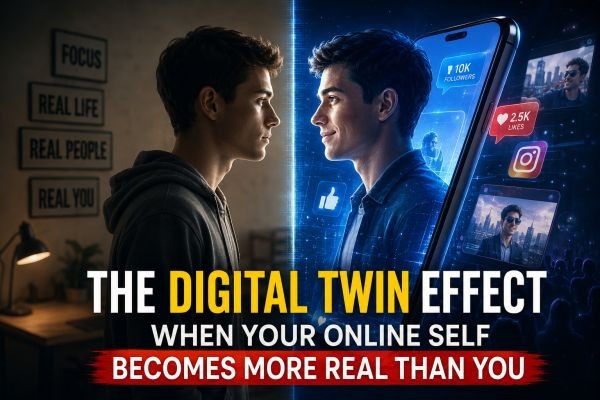
The Digital Twin Effect: When Your Online Self Becomes More Real Than You
Imagine this.
Your Instagram profile looks perfect.
Your LinkedIn shows constant achievements.
Your WhatsApp status reflects confidence.
Your gaming avatar is respected.
Your AI chatbot conversations know your secrets.
But then one day, you sit alone in your room and ask yourself:
"Which version of me is actually real?"
The one living behind the screen?
Or the one looking at the screen?
Welcome to the Digital Twin Effect—a modern phenomenon where our online identity slowly becomes more important, more influential, and sometimes even more real than our physical self.
And the strange part?
Most people don't even realize it's happening.
What Is the Digital Twin Effect?
Traditionally, a "digital twin" was a technology concept.
Engineers created digital replicas of machines, factories, and systems to predict behavior.
Today, humans have unknowingly created something similar.
A digital version of themselves.
Every photo uploaded.
Every tweet posted.
Every story shared.
Every search made.
Every AI conversation saved.
Together, these pieces form a second version of you—a digital twin that exists online 24/7.
Unlike the real you, this version never sleeps.
It never forgets.
And increasingly, it influences how others see you.
Sometimes more than reality itself.
The Day Your Online Reputation Became Your Real Reputation
Twenty years ago, reputation existed mostly in neighborhoods.
People knew you through conversations.
Today, people often meet your profile before they meet you.
Think about it.
Before hiring someone:
People check LinkedIn.
Before dating someone:
People check Instagram.
Before trusting someone:
People search Google.
Before collaborating:
People review social media.
Your digital presence has become your first impression.
And first impressions are powerful.
For many people, their online version is now their primary identity.
The Rise of Curated Reality
The internet doesn't reward reality.
It rewards presentation.
A vacation photo captures one happy moment.
Not the stress before the trip.
A gym selfie captures progress.
Not months of self-doubt.
A success post celebrates achievement.
Not years of failure.
Gradually, we begin editing ourselves.
Not just our photos.
Our personalities.
Our opinions.
Even our emotions.
And after enough editing, something strange happens.
The online version starts looking better than the real one.
Why We Start Living for the Digital Version
Humans naturally seek approval.
In ancient times, approval came from tribes and communities.
Today it comes from likes, views, followers, shares, and comments.
Every notification triggers a small psychological reward.
The brain interprets it as social acceptance.
Over time, many people begin optimizing life for online reactions rather than personal experiences.
A meal becomes content.
A trip becomes content.
A relationship becomes content.
Even grief becomes content.
The moment is no longer the goal.
The post is.
The Mirror That Never Stops Watching
Social media acts like a permanent mirror.
But unlike a normal mirror, it talks back.
It counts likes.
Measures popularity.
Tracks engagement.
Ranks attractiveness.
Compares success.
Every day, people are exposed to thousands of carefully selected highlights from other people's lives.
The result?
Many begin judging their everyday reality against everyone's best moments.
It's an impossible competition.
Yet millions participate in it daily.
The Dangerous Shift: Becoming a Character
At first, online identity is just a representation.
Then it becomes a performance.
Eventually, it becomes a character.
You start asking:
- What would my followers like?
- How should I respond publicly?
- Does this fit my image?
- Will people approve?
Slowly, authenticity is replaced by branding.
The person becomes a product.
The human becomes a profile.
And the digital twin starts controlling the original.
AI Is Accelerating the Effect
Artificial intelligence has introduced a completely new layer.
AI now helps people:
- Write posts
- Generate photos
- Create avatars
- Clone voices
- Produce videos
- Simulate personalities
For the first time in history, technology can help build an identity that is more polished than reality itself.
Some influencers already use AI-generated versions of themselves.
Some companies create virtual employees.
Some people interact more with AI companions than with real friends.
The boundary between authentic identity and digital identity is becoming increasingly blurred.
When Your Digital Twin Knows You Better Than You Do
This may sound unsettling, but think about it.
Your phone knows:
- Where you go
- What you buy
- What you watch
- What you search
- What keeps you awake at night
Algorithms often predict your interests before you consciously recognize them.
Streaming platforms know what you'll watch.
Shopping apps know what you'll buy.
Social networks know what will keep you scrolling.
Your digital twin is becoming a detailed behavioral map.
A version of you built from data.
And in some ways, it may understand your habits better than your closest friends do.
The Loneliness Paradox
Ironically, the more connected humanity becomes online, the more isolated many people feel.
Why?
Because connection and visibility are not the same thing.
Thousands may see your posts.
Very few may truly know you.
A person can have:
- 50,000 followers
- Hundreds of likes
- Endless notifications
And still feel completely alone.
The digital twin receives attention.
The real person often receives less.
The Future: Multiple Versions of You
The next decade may bring something even stranger.
Imagine:
- AI assistants trained on your personality
- Virtual versions of yourself working online
- Digital avatars attending meetings
- AI-generated memories and experiences
Future generations may maintain several identities simultaneously.
A professional identity.
A gaming identity.
A social identity.
An AI-assisted identity.
The question won't be whether you have a digital twin.
The question will be how many versions of yourself exist.
Can We Escape the Digital Twin Effect?
Probably not.
The internet is now woven into modern life.
But awareness changes everything.
The goal isn't to reject technology.
The goal is to remain conscious of it.
Ask yourself:
- Am I living experiences or documenting them?
- Am I expressing myself or performing?
- Does my online identity reflect reality?
- If social media disappeared tomorrow, who would I be?
These questions matter because identity shapes every decision we make.
And the more disconnected we become from our authentic selves, the harder it becomes to recognize who we truly are.
The Final Thought
Perhaps the greatest challenge of the digital age isn't artificial intelligence.
It isn't virtual reality.
It isn't social media.
It's remembering that behind every profile, every avatar, every username, and every carefully crafted post is a human being.
A real person.
A complicated person.
An imperfect person.
And maybe that's exactly what makes us valuable.
Because your digital twin can imitate your life.
It can display your achievements.
It can archive your memories.
It can even predict your behavior.
But it can never fully replace the person sitting behind the screen.
At least not unless you let it.