The Fourth Revolution: How AI Is Changing Humanity's Place in the World
Every few centuries, humanity experiences a shift so profound that it changes how we see ourselves. Artificial intelligence may be the next one.
Throughout history, there have been moments when a single idea completely transformed humanity's understanding of reality.
The first time it happened, we learned that Earth was not the center of the universe.
The second time, we discovered that humans were not separate from nature but a product of evolution.
The third time, psychology revealed that we are not fully in control of our own minds.
Each revelation forced humanity to rethink its place in the world.
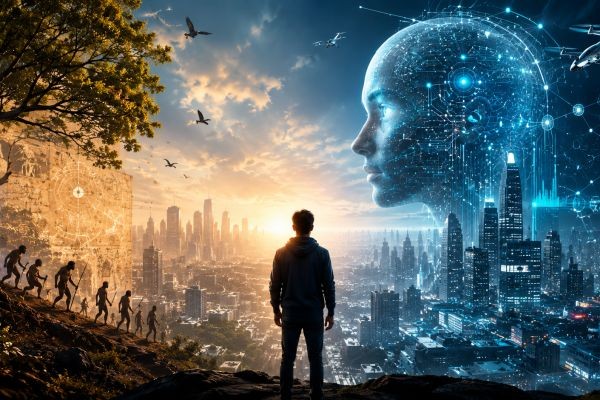
Now, many thinkers believe we are entering a Fourth Revolution—one driven by artificial intelligence.
And unlike previous revolutions, this one isn't just changing what we know.
It's changing what it means to be human.
The Three Revolutions That Changed Everything
Before understanding the AI revolution, it helps to understand the ones that came before it.
The First Revolution: We Are Not the Center of the Universe
For thousands of years, people believed Earth occupied the center of existence.
The sun, moon, and stars were thought to revolve around us.
Then astronomers challenged that belief.
The realization that Earth was just one planet orbiting an ordinary star changed humanity forever.
Suddenly, we were no longer the center of the cosmos.
We were part of something much larger.
The Second Revolution: We Are Part of Nature
The next shock arrived through evolutionary theory.
Before it, many believed humans occupied a completely unique position separate from the animal kingdom.
Then scientists revealed something uncomfortable.
Humans evolved through the same natural processes as every other living creature.
We weren't outside nature.
We were part of it.
This transformed how we understood life itself.
The Third Revolution: We Don't Fully Control Ourselves
The third revolution came from psychology.
For centuries, people assumed rational thought governed human behavior.
But psychological research suggested otherwise.
Emotions, instincts, subconscious influences, and hidden biases shape many of our decisions.
The mind turned out to be far more complex than anyone imagined.
Humans weren't always the rational beings they believed themselves to be.
The Fourth Revolution Has Already Begun
Today, artificial intelligence is introducing another unsettling possibility.
What if intelligence itself is not uniquely human?
For centuries, humanity treated intelligence as its defining characteristic.
Animals could run faster.
Birds could fly.
Fish could swim.
But humans could think.
Thinking was our superpower.
Then AI arrived.
And suddenly machines began performing tasks once considered exclusively human.
Writing.
Research.
Translation.
Art generation.
Medical analysis.
Programming.
Problem-solving.
The line between human intelligence and machine intelligence began to blur.
Why AI Feels Different From Previous Technologies
Most inventions extend human abilities.
Cars help us move faster.
Cranes help us lift heavier objects.
Computers help us calculate more efficiently.
AI is different.
Instead of extending physical abilities, it extends cognitive abilities.
For the first time, humans are creating tools that can perform tasks associated with thinking itself.
That distinction matters.
Because it challenges one of humanity's deepest assumptions:
What makes us special?
Are We Creating a New Kind of Intelligence?
One of the most fascinating questions of the 21st century is whether AI represents a tool or something entirely new.
When calculators appeared, nobody wondered if they were intelligent.
When search engines emerged, nobody questioned their consciousness.
But advanced AI systems create a strange feeling.
They communicate.
They solve problems.
They generate ideas.
They appear to understand language.
This raises questions that philosophers have debated for decades:
-
What is intelligence?
-
What is consciousness?
-
What separates human thought from machine computation?
-
Can intelligence exist without emotions?
-
Can understanding exist without experience?
Humanity may spend decades exploring these questions.
The Shift From Information Scarcity to Information Abundance
For most of history, knowledge was rare.
Books were expensive.
Education was limited.
Information traveled slowly.
Today, AI can provide answers to millions of questions within seconds.
Knowledge is becoming abundant.
And abundance changes value.
When information becomes easy to access, other qualities become more important.
Such as:
-
Wisdom
-
Creativity
-
Judgment
-
Emotional intelligence
-
Ethical reasoning
AI may not eliminate the need for human thinking.
It may redefine which kinds of thinking matter most.
Humanity's New Mirror
Perhaps the most unexpected effect of AI is that it acts as a mirror.
By attempting to recreate intelligence, we are forced to examine our own.
Every breakthrough in AI raises new questions about ourselves.
How do humans learn?
How do humans reason?
How do humans create?
How do emotions influence decisions?
In trying to build intelligent machines, humanity is discovering more about human nature.
AI isn't just teaching machines about us.
It's teaching us about ourselves.
The Fear of Becoming Obsolete
Not everyone views this revolution positively.
Many fear that AI could make human skills less valuable.
Workers worry about automation.
Students worry about future careers.
Artists worry about creativity.
Professionals wonder whether years of expertise will remain relevant.
These fears are understandable.
Whenever technology transforms society, uncertainty follows.
But history suggests that humanity adapts remarkably well.
The challenge isn't simply surviving technological change.
It's learning how to evolve alongside it.
A Future of Human-AI Partnership
Contrary to popular science fiction stories, the future may not be humans versus machines.
It may be humans with machines.
Already, doctors use AI for diagnosis.
Engineers use AI for design.
Writers use AI for research.
Scientists use AI for discovery.
Rather than replacing people entirely, AI often amplifies human capabilities.
The most successful individuals may not be those who compete against AI.
They may be those who learn how to collaborate with it.
The Real Question Isn't About Machines
Many discussions focus on what AI will become.
But perhaps the more important question is:
What will humans become?
If machines handle routine work, humans may focus more on:
-
Creativity
-
Innovation
-
Relationships
-
Exploration
-
Meaning-making
The AI revolution may not simply transform technology.
It may transform human priorities.
The Search for Meaning in an Intelligent Age
As AI becomes more capable, humanity may face a philosophical challenge.
If intelligence is no longer uniquely human, where do we find our value?
Perhaps our worth never came solely from intelligence.
Perhaps it comes from something deeper.
Our ability to love.
To imagine.
To dream.
To experience beauty.
To create meaning from existence.
Machines may process information.
But humans experience life.
And that distinction may become increasingly important in the decades ahead.
The World After the Fourth Revolution
No one knows exactly where artificial intelligence will lead.
It may create extraordinary opportunities.
It may disrupt industries.
It may solve problems that have challenged humanity for centuries.
Or it may force society to rethink its assumptions about work, intelligence, and identity.
What seems certain is this:
Humanity is entering a new chapter.
A chapter as significant as the discoveries that transformed astronomy, biology, and psychology.
The Fourth Revolution isn't merely technological.
It's philosophical.
It's cultural.
It's existential.
And it's happening right now.
Final Thoughts
Every revolution changes humanity's understanding of itself.
The first taught us we are not the center of the universe.
The second taught us we are part of nature.
The third taught us we do not fully understand our own minds.
The fourth may teach us that intelligence is bigger than humanity alone.
Yet rather than diminishing our importance, this realization could deepen our understanding of what truly makes us human.
Because in a world increasingly filled with intelligent machines, our greatest strengths may not be our calculations or our productivity.
They may be our curiosity, compassion, imagination, and ability to find meaning in existence.
The Fourth Revolution is not just changing technology.
It is changing humanity's place in the world.