The Population Debate: Can the Earth Sustain Unlimited Growth?
Introduction: A Planet Under Pressure
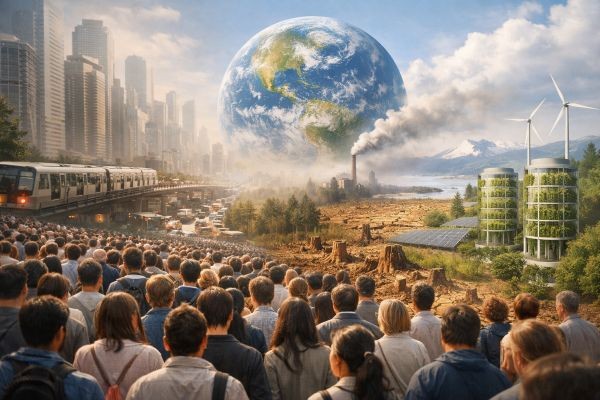
Imagine standing in a city so crowded that every street feels packed, every train is overflowing, and every apartment building stretches endlessly toward the sky. Now imagine that scene expanding across the entire planet.
The world's population recently crossed 8 billion people, a milestone that sparked both celebration and concern. On one hand, it reflects remarkable advances in medicine, agriculture, and human survival. On the other, it raises an uncomfortable question:
How many people can Earth actually support?
For decades, scientists, economists, environmentalists, and policymakers have debated whether population growth is humanity's greatest challenge—or whether innovation can continue to solve the problems that come with a growing population.
The answer isn't as simple as "too many people" or "not enough resources." It sits somewhere in the complex intersection of technology, consumption, economics, and environmental limits.
Understanding Population Growth
Human population growth has not been constant throughout history.
For thousands of years, the global population increased slowly due to high mortality rates, disease, and limited food supplies. Then came the Industrial Revolution.
Advances in:
-
Medicine
-
Sanitation
-
Agriculture
-
Transportation
-
Technology
dramatically reduced death rates and increased life expectancy.
As a result:
-
1800: Around 1 billion people
-
1930: Around 2 billion
-
1974: Around 4 billion
-
2022: Over 8 billion
Humanity doubled its population multiple times within just a few generations.
This unprecedented growth has transformed economies and societies—but it has also intensified pressure on Earth's resources.
The Core Concern: Earth's Carrying Capacity
The term carrying capacity refers to the maximum population an environment can sustain without permanently damaging the ecosystem.
For animals in nature, carrying capacity is largely determined by:
-
Food availability
-
Water resources
-
Habitat space
-
Predation
-
Disease
Humans are different because we use technology to expand these limits.
When food becomes scarce, we invent better farming methods.
When water becomes limited, we build reservoirs and desalination plants.
When space runs out, we build vertically.
This ability to innovate has repeatedly pushed back predictions of collapse.
Yet the question remains:
Can innovation continue forever?
Why Some Experts Believe Unlimited Growth Is Impossible
Many environmental scientists argue that infinite growth on a finite planet is fundamentally impossible.
Their concerns include:
Resource Depletion
Every person requires resources:
-
Food
-
Water
-
Energy
-
Housing
-
Transportation
As population grows, demand increases.
Freshwater aquifers are being depleted faster than they can naturally recharge in many regions. Agricultural land faces erosion and degradation. Certain minerals used in technology are becoming harder and more expensive to extract.
The planet's resources may be vast, but they are not unlimited.
Climate Change
Population growth contributes to higher energy demand and increased greenhouse gas emissions.
More people typically mean:
-
More transportation
-
More electricity consumption
-
More manufacturing
-
More waste production
While population is not the only driver of climate change, it amplifies existing environmental pressures.
Critics argue that if billions more people adopt high-consumption lifestyles, the strain on the climate could become even more severe.
Biodiversity Loss
Human expansion often comes at the expense of natural ecosystems.
Forests are cleared for:
-
Agriculture
-
Infrastructure
-
Housing
-
Industry
As habitats disappear, species face extinction.
Scientists warn that Earth is already experiencing one of the fastest rates of biodiversity loss in its history.
Food Security Challenges
Global food production has increased dramatically over the last century.
However, challenges remain:
-
Droughts
-
Soil degradation
-
Extreme weather events
-
Water shortages
Feeding billions more people may require significant advances in agricultural efficiency.
Without them, food insecurity could become more widespread.
The Opposing View: Why Some Believe Growth Is Sustainable
Not everyone sees population growth as a threat.
Many economists and technologists argue that people are not merely consumers of resources—they are creators of solutions.
Their perspective centers on innovation.
Human Ingenuity Changes the Equation
Throughout history, dire predictions about resource shortages have often been proven wrong.
For example:
When experts feared food shortages in the 20th century, the Green Revolution dramatically increased agricultural yields through improved crops and farming techniques.
When energy demand surged, new technologies expanded access to power.
Innovation repeatedly shifted what seemed possible.
Supporters of this view argue that future breakthroughs in:
-
Artificial Intelligence
-
Renewable energy
-
Vertical farming
-
Biotechnology
-
Fusion energy
could dramatically increase Earth's effective carrying capacity.
Falling Birth Rates Worldwide
One surprising trend is that many countries are no longer experiencing rapid population growth.
In fact, some nations are facing the opposite problem.
Countries across Europe and East Asia have birth rates below replacement levels.
As societies become wealthier and more educated, families often choose to have fewer children.
Many demographers predict that global population growth will eventually slow and stabilize rather than continue indefinitely.
Consumption Matters More Than Population
Another argument challenges the assumption that population alone is the problem.
A person living a highly resource-intensive lifestyle may consume dozens of times more energy and materials than someone living in a lower-income region.
This raises a different question:
Is the real issue the number of people—or how resources are consumed?
Some researchers argue that reducing waste and improving efficiency could have a greater environmental impact than focusing solely on population growth.
The Hidden Factor: Unequal Resource Distribution
One of the biggest misconceptions in the population debate is that scarcity always results from insufficient resources.
In many cases, the problem is distribution.
Globally:
-
Millions face hunger.
-
Tons of food are wasted every day.
-
Some regions experience water shortages while others waste vast quantities.
-
Wealth and resources remain unevenly distributed.
The challenge may not simply be producing more resources but managing them more effectively.
Technology's Role in the Future
Technology will likely play a decisive role in determining whether Earth can support future populations.
Several innovations show promise:
Vertical Farming
Growing crops indoors in stacked layers can dramatically reduce land use while increasing productivity.
Precision Agriculture
AI-powered farming systems can optimize water, fertilizer, and pesticide use.
Renewable Energy
Solar and wind energy continue becoming cheaper and more efficient.
Desalination
Advanced desalination technologies could provide freshwater to regions facing shortages.
Circular Economies
Instead of a "take, use, throw away" model, circular systems aim to recycle and reuse materials continuously.
These innovations could help reduce humanity's environmental footprint even as populations grow.
A Philosophical Question: How Much Growth Is Enough?
The population debate is not just scientific—it is philosophical.
Modern economies often rely on growth.
Governments seek:
-
Economic expansion
-
Larger workforces
-
Increased productivity
Yet endless growth may conflict with environmental sustainability.
This creates a difficult balancing act:
How do societies maintain prosperity without exceeding planetary limits?
Some thinkers advocate for "sustainable growth."
Others argue for entirely new economic models focused on well-being rather than perpetual expansion.
The debate remains unresolved.
What the Future Might Look Like
Most experts agree on one point:
The future is unlikely to be determined by population numbers alone.
Instead, outcomes will depend on:
-
Technological innovation
-
Resource management
-
Climate adaptation
-
Consumption patterns
-
Government policies
-
Global cooperation
A world of 10 billion people could either face severe environmental crises or achieve unprecedented sustainability, depending on the choices humanity makes today.
Population is only one variable in a much larger equation.
Conclusion
So, can Earth sustain unlimited growth?
From a purely physical perspective, probably not. A finite planet inevitably imposes limits.
However, history has repeatedly shown that human innovation can expand those limits in ways previous generations could not imagine.
The real question may not be whether population growth continues, but whether humanity can develop smarter systems for living within Earth's ecological boundaries.
The future will depend less on how many people inhabit the planet and more on how wisely those people use the resources available to them.
As the population debate continues, one truth becomes increasingly clear:
The challenge is not simply supporting more humans—it is creating a world where both humanity and the planet can thrive together.