
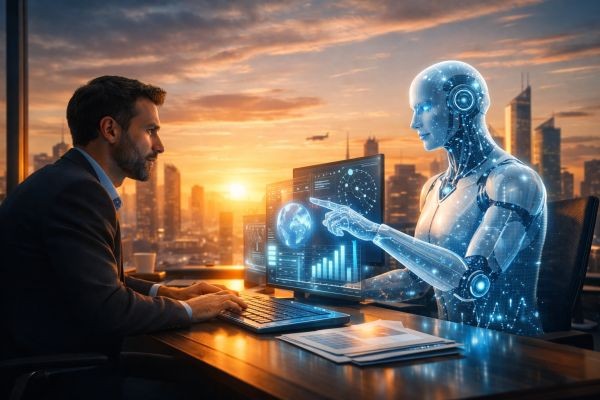
The Rise of Human-AI Teams: Working With Machines Instead of Competing Against Them
For years, the conversation around artificial intelligence has been dominated by one question:
"Will AI replace humans?"
From factory workers to software developers, writers to designers, millions of people have worried that machines are coming for their jobs. Headlines often paint a dramatic picture of a future where algorithms outperform humans in nearly every task.
But what if we're asking the wrong question?
Instead of focusing on humans versus machines, a new reality is emerging across industries worldwide:
Humans and AI are becoming teammates.
The future isn't about competing against intelligent systems. It's about learning how to work alongside them.
And the organizations, professionals, and students who understand this shift early may gain one of the biggest advantages of the coming decade.
The Great AI Fear: Why So Many People Feel Threatened
Every major technological revolution has sparked fear.
When calculators became common, people worried students would forget basic math.
When computers entered offices, many believed administrative jobs would disappear overnight.
When the internet exploded, traditional industries feared complete disruption.
The same pattern is happening with AI today.
People see AI writing articles, generating images, coding software, creating music, and answering complex questions. Naturally, they wonder:
-
What will be left for humans?
-
Will creativity still matter?
-
Will employers prefer machines because they're faster and cheaper?
These concerns are understandable.
However, history suggests something important:
Technology rarely eliminates human value—it changes where human value comes from.
Why AI Is Powerful—but Not Human
Artificial intelligence can process enormous amounts of information in seconds.
It can identify patterns that would take humans days to discover.
It can summarize books, analyze data, generate ideas, and automate repetitive work.
Yet despite all these capabilities, AI lacks something fundamental.
It does not experience life.
It has never felt heartbreak.
It has never celebrated success.
It doesn't understand friendship, fear, ambition, sacrifice, or purpose the way humans do.
AI can simulate empathy.
Humans actually feel it.
AI can generate information.
Humans create meaning.
This difference may become increasingly important as AI becomes more common.
The Real Future: Human-AI Collaboration
Across industries, the most successful professionals are no longer asking:
"How do I compete with AI?"
Instead, they're asking:
"How can AI make me better at what I do?"
This mindset shift is creating what experts call Human-AI Teams.
In these partnerships:
-
AI handles repetitive tasks.
-
Humans focus on strategy.
-
AI provides data.
-
Humans make judgments.
-
AI generates possibilities.
-
Humans choose the best direction.
The result is often far more powerful than either working alone.
Examples of Human-AI Teams Already Changing the World
1. Doctors and AI
Modern healthcare increasingly uses AI to analyze medical scans and detect abnormalities.
In some cases, AI can identify patterns that human eyes might miss.
But patients don't want treatment from an algorithm alone.
They need doctors who can:
-
Understand emotions
-
Explain diagnoses
-
Consider personal circumstances
-
Make ethical decisions
AI becomes the assistant.
The doctor remains the decision-maker.
2. Writers and AI
Many people assume AI will replace writers.
Ironically, many writers now use AI daily.
Writers use AI for:
-
Research assistance
-
Idea generation
-
Outlining
-
Editing suggestions
However, the final voice, perspective, storytelling, and emotional depth still come from the human creator.
Readers connect with experiences, not algorithms.
3. Engineers and AI
Software developers increasingly rely on AI coding assistants.
These tools can generate code, identify bugs, and suggest solutions.
Yet successful software still requires:
-
Problem-solving
-
System design
-
User understanding
-
Business logic
AI accelerates development.
Engineers direct innovation.
4. Teachers and AI
Educational platforms now personalize lessons using AI.
Students receive customized learning paths based on strengths and weaknesses.
But teachers continue to provide:
-
Motivation
-
Mentorship
-
Emotional support
-
Critical thinking guidance
Technology enhances education.
Teachers humanize it.
The New Skill Nobody Talks About
For decades, success was often measured by how much information someone could memorize.
Today, information is available instantly.
The challenge is no longer finding answers.
The challenge is asking better questions.
As AI becomes more accessible, a new skill is rising in importance:
AI Collaboration
This includes:
-
Knowing how to communicate with AI systems
-
Evaluating AI-generated outputs
-
Detecting errors and biases
-
Combining machine insights with human judgment
-
Using AI responsibly
In many professions, this skill may become as important as using computers or the internet.
Why Creativity Is Becoming More Valuable, Not Less
One surprising effect of AI is that creativity may become even more important.
When machines can generate average content instantly, originality becomes rare.
Think about it.
If everyone can create similar AI-generated articles, videos, images, and designs, what stands out?
Human perspective.
Personal experiences.
Unique ideas.
Authentic storytelling.
The future may reward people who can bring something genuinely human to the table.
Not despite AI.
Because of AI.
The Rise of "Centaur Professionals"
A fascinating concept has emerged in technology circles.
It's called the Centaur Model.
The name comes from the mythical creature that is half human and half horse.
In the workplace, a centaur professional combines:
-
Human intuition
-
Human creativity
-
Human judgment
with
-
AI speed
-
AI analysis
-
AI automation
Research consistently shows that teams combining human expertise with AI assistance often outperform both humans alone and AI alone.
The winning formula isn't replacement.
It's partnership.
What Students Should Learn Today
Many students worry that their degree may become irrelevant because of AI.
The truth is more nuanced.
Technical knowledge still matters.
But future success may increasingly depend on skills machines struggle to replicate.
These include:
Critical Thinking
Can you evaluate information rather than simply consume it?
Communication
Can you explain complex ideas clearly?
Emotional Intelligence
Can you understand people, build trust, and lead teams?
Adaptability
Can you learn new tools quickly?
Creativity
Can you generate original ideas and perspectives?
These skills complement AI rather than compete with it.
The Ethical Side of Human-AI Teams
As AI becomes more powerful, ethical questions become increasingly important.
Who is responsible when AI makes mistakes?
How do we prevent bias?
How do we protect privacy?
How do we ensure technology serves humanity rather than controls it?
These questions cannot be answered by algorithms alone.
They require human values.
Human wisdom.
Human accountability.
The more advanced AI becomes, the more important ethical leadership may become.
The Workplace of 2035: What Might It Look Like?
Imagine a typical workday in 2035.
A marketing professional brainstorms campaigns with an AI assistant.
A doctor reviews AI-generated diagnostic insights before meeting patients.
An engineer collaborates with AI systems to test thousands of design possibilities.
A teacher uses AI-generated learning plans while focusing on mentorship and personal development.
The common theme?
Humans aren't disappearing.
They're evolving.
Their role shifts from doing everything manually to guiding increasingly intelligent tools.
The Bigger Question: What Makes Humans Unique?
Perhaps the rise of AI is forcing society to ask a deeper question.
If machines can perform many intellectual tasks, what truly makes us human?
The answer may not lie in productivity.
It may lie in:
-
Curiosity
-
Compassion
-
Imagination
-
Relationships
-
Purpose
-
Conscious experience
These qualities remain uniquely human.
And they may become even more valuable in an AI-powered world.
Final Thoughts
The future is unlikely to be a battle between humans and machines.
Instead, it is shaping up to be a collaboration.
The most successful people won't necessarily be those who resist AI or fear it.
They will be those who learn how to work with it effectively while strengthening the skills that make humans irreplaceable.
Artificial intelligence can process information.
Humans provide meaning.
AI can generate options.
Humans choose directions.
AI can increase efficiency.
Humans define purpose.
The rise of Human-AI teams is not the end of human value.
It may be the beginning of a new chapter—one where technology amplifies human potential rather than replacing it.
The future belongs not to humans or machines alone.
It belongs to those who learn how to combine the strengths of both.