
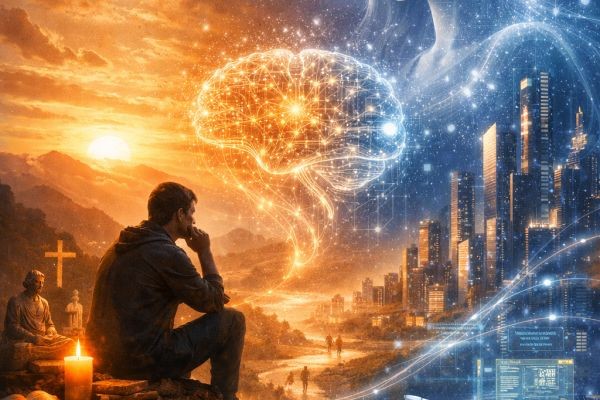
The Search for Meaning in the Age of Artificial Intelligence
What Happens When Machines Learn to Think?
For centuries, humans believed there was something uniquely special about us.
We could reason.
Create art.
Write poetry.
Solve problems.
Imagine the future.
Ask questions about existence itself.
These abilities separated us from every other known species.
Then artificial intelligence arrived.
Suddenly, machines began writing essays, generating images, composing music, and holding conversations that seemed surprisingly human.
The question quickly shifted from:
"What can AI do?"
to
"What makes humans different now?"
And beneath that question lies an even deeper one:
How do we find meaning in a world where intelligence is no longer uniquely human?
Welcome to one of the most important philosophical challenges of the 21st century.
Humanity's Old Source of Meaning
For most of history, meaning came from relatively stable sources.
People found purpose through:
-
Family
-
Religion
-
Community
-
Work
-
Tradition
-
Identity
These systems provided answers to life's biggest questions.
Who am I?
Why am I here?
What should I do with my life?
While different cultures answered differently, the structure remained similar.
Meaning came from belonging to something larger than yourself.
Today, many of those traditional structures are changing.
And AI is accelerating that change.
The AI Revolution Is More Than a Technology Story
Most discussions about artificial intelligence focus on jobs, productivity, and innovation.
Those concerns matter.
But beneath the economic headlines lies a psychological and philosophical transformation.
AI isn't just changing what humans do.
It's changing how humans think about themselves.
For generations, intelligence was considered one of humanity's defining traits.
Now machines can perform many tasks that once required highly skilled human minds.
The result is an uncomfortable question:
If machines can do what we considered uniquely human, where does our value come from?
This question sits at the heart of the modern search for meaning.
The Fear of Becoming Irrelevant
One of the deepest human fears is not failure.
It is irrelevance.
People want to feel needed.
Useful.
Important.
Valuable.
Throughout history, work has provided much of that feeling.
A teacher teaches.
An artist creates.
A writer writes.
An engineer solves problems.
But what happens when AI begins assisting—or even outperforming—humans in many of these areas?
The fear isn't simply losing a job.
It's losing a sense of purpose.
Because for many people, identity and contribution are deeply connected.
The Existential Crisis of Comparison
Social media encouraged humans to compare themselves with other humans.
Artificial intelligence introduces a new kind of comparison.
Now people compare themselves with machines.
A student wonders if AI can learn faster.
A designer wonders if AI can create better.
A writer wonders if AI can write more efficiently.
The comparison becomes endless.
And unlike human competitors, AI never sleeps.
Never gets tired.
Never experiences self-doubt.
This creates a psychological challenge that previous generations never faced.
What If Meaning Was Never About Intelligence?
Perhaps the rise of AI forces us to confront a possibility we've ignored for centuries.
What if human value was never rooted primarily in intelligence?
Consider the people who have shaped your life.
A parent.
A friend.
A mentor.
A partner.
The reason they matter is rarely because they were the smartest person in the room.
They matter because of connection.
Love.
Sacrifice.
Compassion.
Presence.
Meaning often emerges from relationships, not intellectual superiority.
And that may be humanity's greatest advantage.
The Difference Between Intelligence and Consciousness
Artificial intelligence can process information.
Humans experience existence.
This distinction is crucial.
AI can analyze grief.
Humans feel grief.
AI can describe love.
Humans fall in love.
AI can generate poetry about fear.
Humans wake up at 3 a.m. terrified about their future.
There is a profound difference between understanding something conceptually and living through it.
Meaning often comes from experience, not computation.
Why AI May Actually Increase the Search for Meaning
Paradoxically, artificial intelligence may make meaning more important than ever.
As machines become increasingly capable, humans may begin asking deeper questions.
Questions such as:
-
What truly matters?
-
What makes life meaningful?
-
What cannot be automated?
-
What does it mean to live well?
Technology often solves practical problems.
Meaning addresses existential ones.
The more efficient life becomes, the more important purpose becomes.
The Return of Philosophy
For decades, philosophy was often viewed as abstract and impractical.
Today, it feels surprisingly relevant again.
Artificial intelligence is forcing humanity to revisit ancient questions explored by thinkers like:
-
Socrates
-
Aristotle
-
Friedrich Nietzsche
-
Albert Camus
Questions about identity.
Purpose.
Freedom.
Consciousness.
Responsibility.
Far from making philosophy obsolete, AI may be making it essential.
The New Human Advantage
Every technological revolution changes what society values.
The Industrial Revolution increased the value of machines.
The Information Age increased the value of knowledge.
The AI Age may increase the value of distinctly human qualities.
Such as:
Creativity
Not just generating content but imagining new possibilities.
Empathy
Understanding emotions through lived experience.
Wisdom
Knowing not just what can be done, but what should be done.
Courage
Acting despite uncertainty.
Authenticity
Being genuinely human in an increasingly artificial environment.
These qualities are difficult to reduce to algorithms.
The Meaning Economy
Some experts suggest we are entering a new era.
An economy where meaning becomes increasingly valuable.
When information is abundant, wisdom becomes scarce.
When content is endless, authenticity becomes rare.
When efficiency is automated, purpose becomes essential.
People may increasingly seek:
-
Meaningful work
-
Genuine relationships
-
Personal growth
-
Community
-
Self-understanding
Not because technology failed.
But because technology cannot fully satisfy those needs.
The Temptation of Easy Answers
Whenever societies experience major change, people often search for certainty.
AI can appear to provide certainty.
Instant answers.
Instant recommendations.
Instant guidance.
But meaning rarely emerges from easy answers.
It often emerges from:
-
Struggle
-
Reflection
-
Failure
-
Growth
-
Experience
Some of life's most meaningful lessons cannot be downloaded or generated.
They must be lived.
The Future Relationship Between Humans and AI
The future may not be a competition between humans and machines.
It may be a partnership.
AI could handle many tasks that consume time and energy.
Humans could focus more deeply on creativity, relationships, exploration, and meaning.
The challenge will not be building smarter machines.
The challenge will be ensuring that humans remain connected to what makes life worth living.
Because technological progress without human purpose can create a strange emptiness.
What AI Cannot Do
Artificial intelligence can write stories.
But it cannot have childhood memories.
It can discuss loss.
But it cannot lose someone it loves.
It can analyze beauty.
But it cannot stand beneath a sunset and feel awe.
It can describe life.
But it cannot live one.
And perhaps meaning emerges precisely from these experiences.
The fact that life is temporary.
Uncertain.
Fragile.
Human.
Final Thoughts: The Question Behind Every Question
The age of artificial intelligence is forcing humanity into a new conversation.
Not merely about technology.
But about ourselves.
The most important question may not be:
"Can AI think?"
Or even:
"Will AI surpass human intelligence?"
The deeper question is:
"What makes a human life meaningful?"
Because if we can answer that question, the rise of AI becomes less threatening.
Machines may become more intelligent.
They may become more capable.
They may transform society in ways we cannot yet imagine.
But the search for meaning has never been about intelligence alone.
It has always been about how we choose to live.
And in the age of artificial intelligence, that choice remains uniquely, beautifully human.