The Validation Economy: Why Likes and Views Feel Like Survival
Imagine If Your Self-Worth Had a Score
You wake up.
Before your feet touch the floor, you check your phone.
A photo you posted last night has 247 likes.
A reel got 8,000 views.
A comment received five heart emojis.
Instantly, your mood improves.
Now imagine the opposite.
The post barely reaches anyone.
The views stay stuck at 112.
No comments. No shares.
Suddenly, something feels wrong.
Nothing in your real life changed overnight.
You're still the same person.
Yet somehow, you feel less valuable.
Why?
Because we no longer live only in an attention economy.
We live in a Validation Economy.
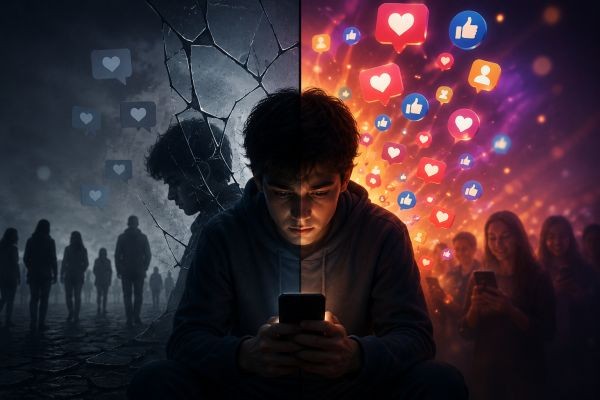
A world where likes, views, followers, and engagement have become emotional currency.
And for millions of people, especially younger generations, that currency feels surprisingly close to survival.
What Is the Validation Economy?
The Validation Economy is a social system where approval, attention, and recognition function like resources.
Just as traditional economies revolve around money, modern digital life revolves around validation.
The more attention you receive, the more valuable you appear.
The less attention you receive, the more invisible you feel.
Social media transformed validation from something occasional into something measurable.
For the first time in human history, popularity became a number.
A number everyone can see.
A number everyone can compare.
A number that updates every second.
Humans Were Never Built for This
For most of human history, validation came from small communities.
Your family.
Your friends.
Your village.
Your workplace.
Maybe a few dozen or hundred people knew who you were.
Today, a teenager can upload a video and instantly compare themselves to someone with ten million followers.
Our brains evolved for tribes.
Not audiences.
They evolved to care about belonging because belonging once meant survival.
Thousands of years ago, being rejected by your tribe could literally mean death.
No protection.
No food.
No community.
No future.
The emotional pain of rejection became deeply wired into human psychology.
The problem?
Your brain still interprets social rejection as a threat.
Even when that rejection comes from strangers online.
Why Likes Feel More Important Than They Should
Logically, most people know that a like doesn't determine their worth.
Emotionally, it's a different story.
Every notification triggers a tiny reward response in the brain.
A new follower.
A heart emoji.
A positive comment.
A repost.
Each one acts like evidence that you matter.
That you're seen.
That you exist.
Without realizing it, many people begin outsourcing self-worth to algorithms.
The question slowly changes from:
"Do I like this?"
to
"Will people like this?"
And that's where the Validation Economy starts controlling behavior.
The Rise of Performance Living
Social media didn't just change communication.
It changed identity.
Many people now experience life twice.
The first experience is living it.
The second is documenting it.
A sunset isn't just a sunset.
It's content.
A vacation isn't just a memory.
It's a post.
Dinner isn't just dinner.
It's a story.
Life slowly becomes a performance.
Not necessarily because people are fake.
But because platforms reward visibility.
The more visible you are, the more validation you receive.
And the more validation you receive, the harder it becomes to stop seeking it.
When Numbers Become Self-Worth
Imagine two artists.
The first creates something meaningful but receives little attention.
The second creates something average but goes viral.
Which artist feels more successful?
Increasingly, society rewards the second.
Visibility often matters more than value.
Attention often matters more than depth.
Reach often matters more than meaning.
This creates a dangerous psychological trap.
People stop measuring themselves by who they are.
They start measuring themselves by metrics.
Followers.
Views.
Likes.
Subscribers.
Shares.
The scoreboard becomes the identity.
The Loneliness Behind Popularity
One of the strangest realities of the Validation Economy is that validation doesn't always reduce loneliness.
Sometimes it increases it.
Many influencers report feeling isolated despite receiving enormous attention.
Why?
Because attention and connection are not the same thing.
Ten thousand likes cannot replace one genuine conversation.
A million views cannot guarantee one person truly understands you.
Validation feels good.
Connection feels meaningful.
Modern platforms often provide the first while quietly starving the second.
The Invisible Competition Nobody Agreed To
Open almost any social media app.
Within minutes, you'll see:
-
Someone younger making more money
-
Someone traveling the world
-
Someone looking more attractive
-
Someone getting more engagement
-
Someone achieving more success
Your brain doesn't care that these are highlights.
It compares anyway.
The result is a competition nobody consciously signed up for.
A global ranking system where everyone feels observed.
And in that environment, validation becomes a form of social status.
Why Gen Z Feels It Most
No generation has spent more time online than Gen Z.
Many grew up documenting their lives from childhood.
For them, digital identity isn't separate from reality.
It's part of reality.
Being ignored online can feel similar to being ignored offline.
Being praised online can feel similar to being praised in person.
As a result, likes and views often carry emotional weight that older generations struggle to understand.
This isn't vanity.
It's adaptation to a world where digital visibility increasingly influences opportunities, relationships, careers, and social belonging.
The Business Model of Validation
Here's the uncomfortable truth.
Platforms profit from your desire for validation.
Every notification is designed to bring you back.
Every like encourages another post.
Every viral moment creates another chase.
Social media companies understand something powerful:
People will work incredibly hard for attention.
Sometimes harder than they work for money.
Because attention satisfies a deeper human need—the need to matter.
The Validation Economy runs on that need.
The Cost of Constant Validation Seeking
When external approval becomes the primary source of self-worth, several things happen:
Creativity declines
People stop creating what they love.
They create what performs.
Authenticity weakens
People hide parts of themselves that might not be rewarded.
Anxiety increases
Every post becomes a test.
Every silence feels like failure.
Identity becomes unstable
Self-worth rises and falls with engagement numbers.
The result is emotional exhaustion disguised as ambition.
The Rebellion Against Validation
Interestingly, a growing number of people are starting to resist.
Some hide like counts.
Some take social media breaks.
Some create anonymously.
Some prioritize private relationships over public recognition.
This rebellion isn't about rejecting technology.
It's about reclaiming self-worth.
It's the realization that validation should be a bonus, not a necessity.
A compliment, not a life support system.
What Real Freedom Looks Like
True freedom in the Validation Economy isn't deleting every app.
It's reaching a point where your value no longer depends on metrics.
Where a post with ten likes and a post with ten thousand likes leave your identity unchanged.
Where creation matters more than reaction.
Where expression matters more than applause.
Where your sense of self exists before the algorithm arrives.
And remains after it leaves.
Final Thoughts: The Price of Being Seen
The Validation Economy didn't emerge because humans became shallow.
It emerged because humans have always wanted the same thing:
To be seen.
To be valued.
To belong.
Social media simply transformed those desires into numbers.
The challenge isn't avoiding validation altogether.
The challenge is remembering that likes measure attention not worth.
Views measure visibility not value.
Followers measure reach not character.
In a world obsessed with being noticed, perhaps the most radical act is remembering who you are when nobody is watching.
Because the moment your self-worth stops depending on the crowd, you become richer than any validation economy can ever make you.