What Defines Life? A Question Scientists Still Can't Answer
Introduction: The Simplest Question That Turns Out to Be the Hardest
Ask a child, "What is alive?" and the answer usually comes quickly.
Dogs are alive. Trees are alive. Humans are alive.
Rocks are not.
Simple enough.
But when scientists try to answer the same question, things become surprisingly complicated. In fact, one of the biggest unsolved mysteries in biology isn't how life began—it's figuring out exactly what life is.
It sounds absurd at first. After all, we are surrounded by living things every day.
Yet despite centuries of scientific progress, researchers still cannot agree on a universal definition of life.
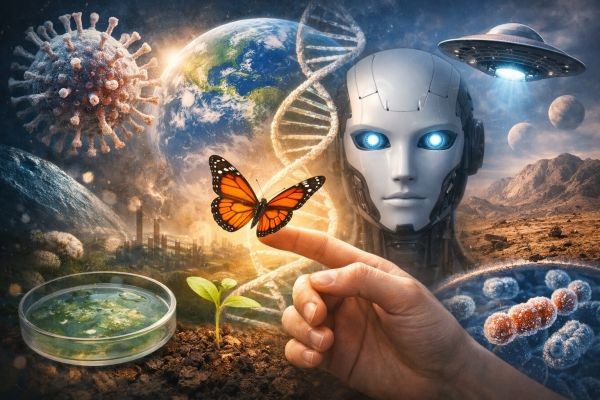
The problem becomes even stranger when we encounter viruses, artificial intelligence, synthetic organisms, and the possibility of extraterrestrial life. Suddenly, the line separating the living from the non-living begins to blur.
So what defines life? And why is one of science's most fundamental questions still unanswered?
Why Defining Life Matters
Most people rarely think about the definition of life because the distinction appears obvious.
However, for scientists, the answer has enormous implications.
A clear definition helps researchers:
-
Search for life on other planets
-
Understand how life originated on Earth
-
Build artificial life in laboratories
-
Determine whether viruses are truly alive
-
Identify the boundaries between biology and technology
Without a precise definition, scientists are essentially trying to study something they cannot fully describe.
Imagine searching the universe for life without being completely sure what life actually is.
That's the challenge modern science faces.
The Traditional Definition of Life
For decades, biology textbooks taught that living things share several key characteristics.
Life generally:
-
Grows and develops
-
Reproduces
-
Uses energy
-
Responds to stimuli
-
Maintains internal balance
-
Evolves over time
-
Consists of cells
At first glance, this checklist seems reasonable.
Humans fit it.
Animals fit it.
Plants fit it.
Bacteria fit it.
Problem solved?
Not quite.
The deeper scientists looked, the more exceptions they discovered.
The Virus Problem
Viruses are one of the biggest reasons the definition of life remains controversial.
Viruses contain genetic material and evolve over time.
They can spread, mutate, and adapt.
Yet they cannot reproduce on their own.
To replicate, a virus must invade a living cell and hijack its machinery.
Outside a host, a virus is essentially inactive.
So what is it?
Alive?
Dead?
Something in between?
Some biologists argue that viruses are living because they evolve and carry genetic information.
Others argue they fail a key requirement of life: independent reproduction.
Viruses sit in a strange gray area where biology becomes less certain.
Fire, Crystals, and Other Strange Cases
Viruses aren't the only challenge.
Consider fire.
Fire can:
-
Spread
-
Consume energy
-
Grow larger
-
React to its environment
These characteristics resemble life.
Yet no scientist considers fire a living organism.
Then there are crystals.
Certain crystals can grow and create repeating structures.
Again, growth alone doesn't make something alive.
These examples reveal an important truth:
No single characteristic seems capable of defining life.
Instead, life appears to emerge from a combination of traits.
But even that solution has limitations.
The NASA Definition
When scientists began seriously searching for life beyond Earth, they needed a working definition.
NASA adopted a widely cited description:
"Life is a self-sustaining chemical system capable of Darwinian evolution."
This definition focuses on two major ideas:
Self-Sustaining
Living systems maintain themselves through internal processes.
They gather energy and use it to survive.
Evolution
Life changes over generations through natural selection.
Species adapt to their environments over time.
This definition works well for most known organisms.
However, it also raises new questions.
What if alien life doesn't use chemistry the way Earth life does?
What if extraterrestrial organisms operate on principles we've never imagined?
A definition based entirely on Earth may be too narrow for a universe we barely understand.
Could Artificial Intelligence Be Alive?
As AI becomes increasingly sophisticated, another question emerges.
Could machines eventually become alive?
Today's AI systems can:
-
Learn from data
-
Adapt behavior
-
Solve problems
-
Communicate
-
Generate new ideas
To many people, these abilities seem remarkably life-like.
Yet AI lacks several characteristics associated with biological life.
It doesn't grow organically.
It doesn't reproduce naturally.
It doesn't evolve through biological processes.
At least not yet.
Some futurists believe future AI systems could blur the line between machines and living entities.
If that happens, humanity may need to rethink its definition of life entirely.
The Search for Alien Life Changes Everything
The challenge becomes even greater when we look beyond Earth.
All known life shares a common ancestry.
Every organism on Earth is based on:
-
DNA or RNA
-
Carbon chemistry
-
Water
But what if life elsewhere isn't?
Scientists have proposed possibilities including:
-
Silicon-based life
-
Plasma life forms
-
Machine civilizations
-
Exotic biochemical systems
The universe may contain forms of life that don't fit any Earth-based definition.
This possibility forces researchers to ask an uncomfortable question:
Are we defining life itself—or merely defining life as we know it?
The Origin of Life Mystery
The difficulty in defining life may stem from another unresolved puzzle:
How did life begin?
Scientists still don't know exactly how non-living matter transformed into living organisms billions of years ago.
At some point, chemistry became biology.
Molecules became self-replicating systems.
Matter became alive.
But where exactly did that transition occur?
Was there a specific moment?
Or did life emerge gradually through countless small steps?
Without understanding life's origin, defining its essence becomes much harder.
Life as a Process Rather Than a Thing
Some modern researchers believe we've been asking the wrong question.
Perhaps life isn't a thing at all.
Perhaps it's a process.
Think about a whirlpool.
The water molecules constantly change.
Yet the whirlpool maintains its identity.
Similarly, the atoms in your body are continually replaced throughout your lifetime.
Yet you remain you.
According to this perspective, life is not the physical material itself.
Life is the organized flow of information, energy, and matter through a system.
This idea shifts the focus away from cells and chemicals and toward patterns and processes.
It may also explain how life could exist in forms very different from those on Earth.
A Philosophical Puzzle as Much as a Scientific One
The definition of life is not merely a biological question.
It is also philosophical.
When we ask what life is, we are really asking deeper questions:
-
What separates us from machines?
-
What makes something an individual?
-
Where does consciousness fit in?
-
Is life defined by matter, information, or experience?
These questions sit at the intersection of science, philosophy, and even spirituality.
And none have easy answers.
The Possibility That There Is No Perfect Definition
Perhaps the most surprising possibility is that life cannot be perfectly defined.
Many concepts in nature exist on a spectrum rather than in clear categories.
Consider:
-
Day and night
-
Hot and cold
-
Young and old
There is rarely a precise dividing line.
Life may work the same way.
Instead of a sharp boundary between living and non-living, there may be a gradual transition filled with ambiguous cases like viruses and future artificial organisms.
If so, the search for a single perfect definition may be impossible.
Conclusion: The Mystery at the Heart of Existence
Humanity has mapped the human genome, landed spacecraft on distant worlds, and built machines capable of remarkable intelligence.
Yet one deceptively simple question remains unresolved:
What is life?
Every proposed definition eventually encounters exceptions.
Viruses challenge our assumptions.
Artificial intelligence raises new possibilities.
The search for extraterrestrial organisms forces us to think beyond Earth.
Perhaps life is not a fixed category but a continuum—a complex process that emerges when matter becomes organized in extraordinary ways.
Until scientists uncover a deeper understanding, the definition of life remains one of humanity's greatest mysteries.
And that mystery reminds us of something profound:
Sometimes the questions we think are simplest turn out to be the deepest of all.