
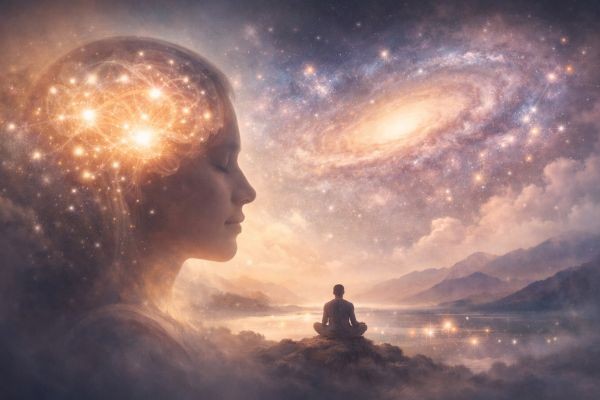
What Is Consciousness? The Biggest Mystery Science Still Can't Explain
You Are Reading These Words Right Now...
Take a moment and notice something strange.
You are aware that you're reading.
You can see the screen.
You can hear sounds around you.
You can feel emotions, memories, thoughts, and sensations.
But here's the question that has puzzled philosophers, scientists, and thinkers for thousands of years:
Why are you conscious at all?
Why isn't your brain simply processing information like a computer?
Why is there a subjective experience attached to being alive?
Why does it feel like something to be you?
This mystery is known as consciousness, and despite centuries of scientific progress, it remains one of the greatest unsolved questions in human history.
In fact, some researchers believe understanding consciousness could be harder than understanding the origins of the universe itself.
What Exactly Is Consciousness?
At its simplest level, consciousness is awareness.
It is the experience of being.
The fact that you don't just process reality—you experience it.
When you see a sunset, something happens beyond the detection of light.
When you listen to music, you don't merely register sound waves.
You feel something.
When you taste chocolate, there is a personal experience attached to that sensation.
Scientists often describe consciousness as:
The subjective experience of awareness.
The challenge is that awareness itself cannot easily be measured.
We can study brains.
We can observe behavior.
But we cannot directly observe someone else's conscious experience.
The Problem Nobody Can Solve
Imagine a scientist examining your brain.
They can identify:
-
Neurons firing
-
Electrical activity
-
Chemical reactions
-
Brain regions becoming active
But none of these observations explain one crucial thing:
Why does any of it feel like something?
A computer processes information.
A calculator processes information.
An AI model processes information.
Yet there is no evidence they experience anything.
Your brain also processes information.
But somehow it creates awareness.
The question is:
How?
And that's where science encounters one of its greatest mysteries.
The Hard Problem of Consciousness
In the 1990s, philosopher David Chalmers introduced a famous concept called The Hard Problem of Consciousness.
The "easy problems" involve explaining things like:
-
Memory
-
Attention
-
Decision-making
-
Sensory processing
These are difficult scientifically but theoretically solvable.
The hard problem is different.
It asks:
Why does physical brain activity produce subjective experience at all?
Why do electrical signals become feelings?
Why does matter become awareness?
Why does the universe seem to experience itself through conscious beings?
Nobody knows.
Your Brain Is Made of Ordinary Matter
This makes the mystery even stranger.
Your brain consists of:
-
Water
-
Proteins
-
Fat
-
Electrical signals
-
Atoms
Nothing obviously magical.
Nothing obviously conscious.
Yet somehow, these ordinary ingredients combine to create:
-
Thoughts
-
Dreams
-
Emotions
-
Memories
-
Imagination
-
Self-awareness
How does unconscious matter create conscious experience?
Science currently lacks a complete answer.
The Zombie Thought Experiment
Philosophers often use a fascinating idea called the Philosophical Zombie.
Imagine a person who looks exactly like you.
They talk like you.
Act like you.
Laugh like you.
Cry like you.
From the outside, they're indistinguishable.
But internally, they experience nothing.
No feelings.
No awareness.
No consciousness.
Just automatic behavior.
The question is:
What makes you different from that zombie?
What creates the inner world of experience?
This thought experiment highlights how difficult consciousness is to explain.
Is Consciousness an Illusion?
Some scientists argue that consciousness may not be what we think it is.
According to this view, awareness itself could be an elaborate illusion generated by the brain.
The brain creates a story about a unified self.
But perhaps that self doesn't truly exist.
This idea appears in both modern neuroscience and ancient spiritual traditions.
However, critics point out a fascinating problem:
Even if consciousness is an illusion, someone still has to experience the illusion.
The mystery remains.
Could Consciousness Be Fundamental?
Another radical possibility is that consciousness isn't created by the brain.
Perhaps consciousness is a fundamental feature of reality itself.
Just as space, time, and gravity exist throughout the universe, some philosophers suggest awareness may also exist at a basic level.
This idea is called Panpsychism.
According to panpsychism:
-
Consciousness may exist in simple forms throughout nature.
-
Complex consciousness emerges from more complex systems.
-
Awareness could be woven into the fabric of reality itself.
While controversial, this theory has gained renewed attention in recent years.
What Does Quantum Physics Have to Do With It?
Whenever consciousness is discussed, quantum physics often enters the conversation.
Some thinkers speculate that consciousness and quantum mechanics may be connected.
The reasoning is simple.
Both subjects seem mysterious.
Both challenge common intuition.
Both remain partially unexplained.
However, there is currently no scientific consensus linking consciousness directly to quantum phenomena.
Many researchers remain skeptical.
Still, the possibility continues to fascinate scientists and philosophers alike.
Can Artificial Intelligence Become Conscious?
The rise of AI has added a new layer to the consciousness debate.
Artificial intelligence can:
-
Write essays
-
Generate images
-
Solve problems
-
Hold conversations
But is it conscious?
Most experts would say:
We don't know.
The difficulty is that consciousness cannot be directly observed.
We infer consciousness in other humans because they behave similarly to us.
But how would we recognize consciousness in a machine?
Could an AI become self-aware?
Or would it merely simulate awareness?
The answer may redefine what it means to be human.
Why Consciousness Matters
This isn't merely an abstract philosophical question.
Consciousness influences nearly everything.
It affects how we think about:
-
Human identity
-
Free will
-
Morality
-
Artificial intelligence
-
Life after death
-
Animal rights
-
Mental health
Understanding consciousness could fundamentally change our understanding of reality.
It might even change how we understand ourselves.
The Strange Experience of Being You
Perhaps the most remarkable thing about consciousness is how familiar it feels.
We experience it every moment.
Yet we rarely stop to examine it.
Think about it.
You exist inside a universe filled with billions of galaxies.
You are made of atoms formed in ancient stars.
And somehow, those atoms have organized themselves into a being capable of asking questions about existence.
That fact alone is astonishing.
The universe has produced creatures capable of wondering why the universe exists.
And consciousness is the bridge that makes that wonder possible.
What Ancient Philosophers Thought
Long before neuroscience existed, philosophers wrestled with consciousness.
René Descartes
Descartes famously declared:
"I think, therefore I am."
For him, consciousness was the one thing impossible to doubt.
Plato
Plato believed reality extended beyond the physical world and that the mind connected to deeper truths.
Eastern Philosophies
Many Eastern traditions viewed consciousness not as a byproduct of matter but as a fundamental aspect of existence itself.
Interestingly, some modern theories echo these ancient ideas.
Will Science Ever Solve Consciousness?
This is perhaps the biggest question of all.
Some researchers believe breakthroughs in neuroscience will eventually explain awareness completely.
Others argue consciousness may be fundamentally beyond scientific understanding.
There is even a possibility that human brains are simply not equipped to fully comprehend consciousness.
Just as a fish cannot understand astronomy, humans may have cognitive limits.
If true, consciousness could remain a mystery forever.
Final Thoughts: The Mystery Looking Back at Itself
Consciousness is unique among scientific mysteries.
Black holes don't wonder about black holes.
Galaxies don't question galaxies.
Atoms don't contemplate atoms.
But conscious beings can investigate consciousness.
The mystery is studying itself.
Perhaps that is why the question feels so profound.
What is consciousness?
Nobody knows for certain.
Yet every attempt to answer it reveals something extraordinary:
The fact that you are aware enough to ask the question may already be one of the most remarkable phenomena in the universe.
And until science finds an answer, consciousness will remain the greatest mystery hiding in plain sight—inside every human mind.