
What Just Changed? The Stories Quietly Shaping Our Future
Some changes arrive with a bang.
Others happen so quietly that we don't notice them until they have already become part of everyday life.
Think about how quickly things changed around us. Paying for a coffee without cash became normal. Asking AI to write code became normal. Working from a laptop became normal. And now, we're entering another phase where AI can complete tasks rather than simply answer questions.
None of these changes happened overnight.
They happened one small step at a time.
That is exactly what makes the current moment so interesting.
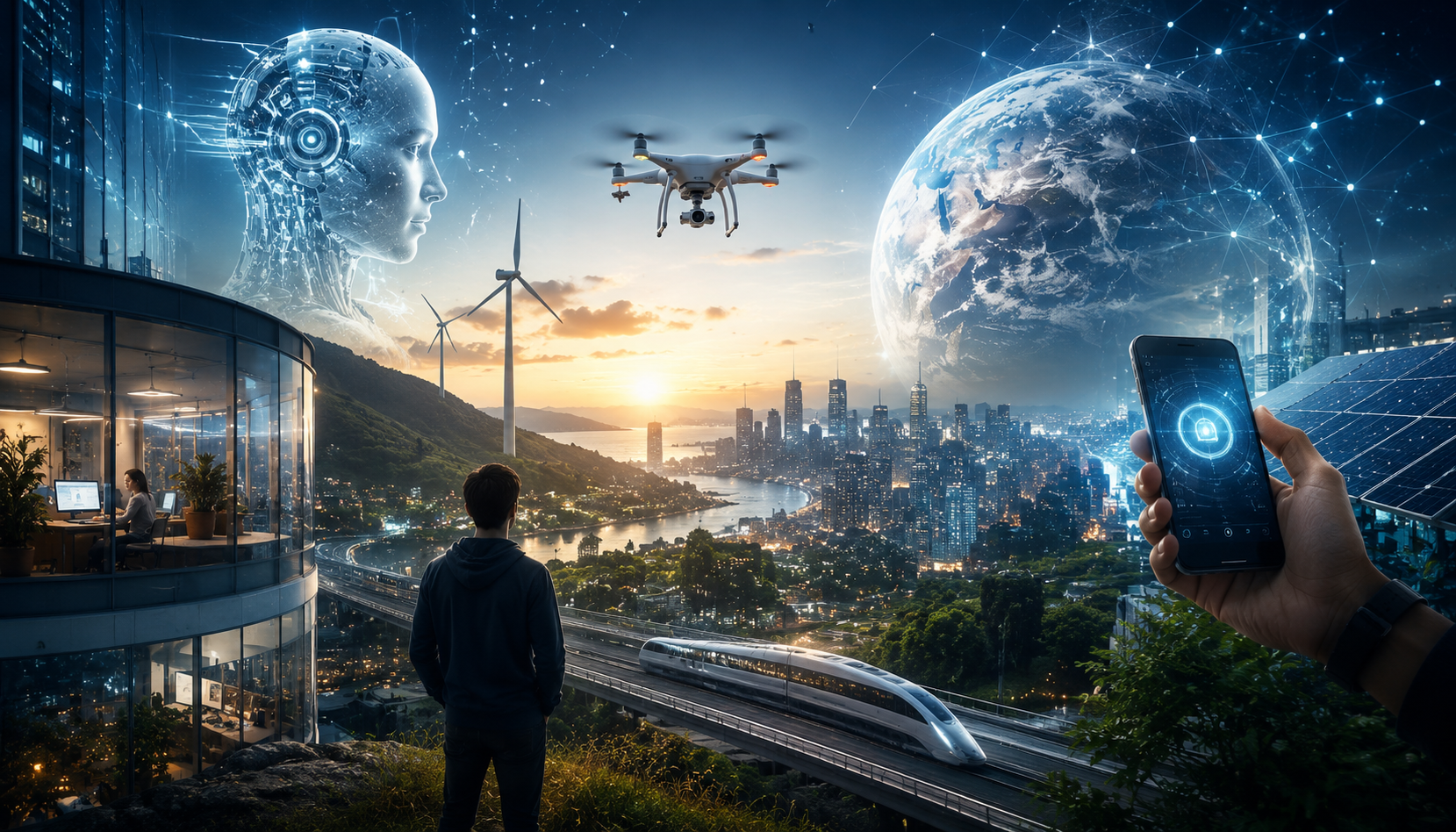
In 2026, several developments are moving from experiments into the real world. AI agents are entering workplaces, digital payments are becoming infrastructure, data centres are changing electricity demand, clean energy is scaling, and employers are rethinking the skills they need.
These stories may not always dominate the front page.
But they could have a much bigger impact on your life than you expect.
Here are seven changes quietly shaping the future.
1. AI Is Moving From “Answering” to “Doing”
For years, the easiest way to explain AI was simple:
You ask a question.
AI gives you an answer.
That model is changing.
The next generation of AI agents is designed to take on longer tasks, use software tools, analyze information and work through multiple steps with less human intervention.
In June 2026, OpenAI reported that its own employees were increasingly using agentic AI for longer-running tasks, with adoption spreading beyond engineering into areas such as legal, finance and recruiting.
That shift is important because it changes what people expect from AI.
Instead of saying:
“Write me a report.”
A user may increasingly say:
“Research this topic, compare the information, organize the findings and prepare a draft.”
The difference sounds small.
Technologically, it is enormous.
AI is moving from being a digital assistant toward becoming something closer to a digital colleague.
But there is an important catch.
More automation doesn't mean humans become unnecessary.
A recent International Labour Organization report found that AI adoption is increasing demand for AI literacy, digital skills, adaptability, resilience and higher-order cognitive and social skills.
The future may therefore belong less to people who simply “know AI” and more to people who know when to trust it, when to question it and how to use it effectively.
Why this matters
Your job may not disappear because of AI.
But the way you perform your job is very likely to change.
2. The Most Valuable Skill May Be Knowing What AI Gets Wrong
Here's an unexpected side effect of the AI boom.
As machines become better at generating answers, human judgment becomes more valuable.
AI can summarize a 50-page document in seconds.
But should you trust the summary?
It can generate business ideas.
But which idea actually makes sense?
It can write code.
But does the code solve the right problem?
It can analyze data.
But what happens if the data itself is misleading?
This is why the future of work isn't simply about learning more AI tools.
It's about developing the ability to evaluate AI output.
The World Economic Forum has highlighted the growing importance of human judgment as AI becomes better at analysis, prediction and content generation.
And that could change education too.
Memorizing information is becoming less valuable when information is instantly available.
Critical thinking, communication, problem-solving, creativity and domain expertise become more important.
In other words, the future worker may need to be both:
AI-enabled + human-led.
That combination could become one of the most valuable career advantages of the next decade.
3. India's UPI Story Is Becoming Bigger Than Payments
For millions of Indians, scanning a QR code and paying instantly doesn't feel revolutionary anymore.
It's just normal.
That's exactly why the transformation is so significant.
In August 2026, India's UPI system completed ten years. Government data shows that annual UPI transactions grew from just 1.78 crore in FY2016-17 to more than 24,162 crore in FY2025-26. UPI was operational in 11 countries by 2026.
And the growth continues.
UPI processed about 2,365.8 crore transactions worth ₹29.87 lakh crore in July 2026 alone, according to government data.
This isn't simply a story about people replacing cash with smartphones.
It is about building digital public infrastructure.
Payments are becoming faster, cheaper and increasingly connected to other financial services.
The bigger question is what comes next.
Could digital payment systems become gateways to credit, savings, insurance and cross-border financial services?
Could India's experience influence how other countries build their own digital economies?
The answer may become clearer over the next few years.
The quiet change
We are moving from an economy where digital payments were an option to one where digital payments are becoming basic infrastructure.
4. AI Has Created an Unexpected Problem: Electricity
Here's something most people don't think about when they use an AI chatbot.
Every question requires computing power.
Computing power requires data centres.
And data centres require electricity.
As AI becomes more powerful, the physical infrastructure behind it is becoming a major economic story.
The International Energy Agency expects global electricity demand to grow faster in 2026 and 2027, with data centres, electric vehicles, cooling, industry and other electricity-intensive activities contributing to the increase. Global electricity demand is forecast to rise 3.6% in 2026 and 3.8% in 2027.
The scale of AI infrastructure is becoming enormous.
For example, Reuters reported in August 2026 that Anthropic was planning a multibillion-dollar arrangement for AI computing capacity involving hundreds of megawatts of power.
This means the AI race is no longer only about software.
It is also about:
chips + data centres + electricity + cooling + networks.
And that changes the geography of technology.
Countries with abundant electricity, strong grids, semiconductor access and suitable infrastructure could become increasingly attractive locations for AI development.
The AI revolution may therefore become an energy revolution too.
5. The Semiconductor Race Is Becoming a Global Economic Race
You probably don't think about semiconductors when you open your phone.
But almost every modern technology depends on them.
Smartphones.
Cars.
Servers.
Medical equipment.
AI systems.
Robots.
Defence technology.
And now, demand for advanced chips is being driven heavily by artificial intelligence.
South Korea's exports, for example, are benefiting from strong global demand for AI-related semiconductors. Reuters reported that the country's August 2026 export outlook remained strong because of surging chip demand.
Meanwhile, Nvidia's latest outlook has reinforced expectations that AI infrastructure spending still has significant room to grow.
This creates a new kind of competition.
Countries aren't only competing to build the best AI model.
They're competing to control the infrastructure underneath it.
That includes:
- Advanced semiconductor manufacturing
- AI processors
- Memory chips
- Data centres
- Electricity infrastructure
- Cloud computing
- Supply chains
The semiconductor industry is therefore becoming much more than a technology sector.
It is becoming part of economic security and national strategy.
6. Renewable Energy Is Quietly Becoming an Infrastructure Story
Climate change is usually discussed through temperatures, extreme weather and emissions.
But another transformation is happening underneath the headlines:
the rapid expansion of clean electricity.
According to the IEA, global renewable capacity additions reached a record 800 GW in 2025, with solar accounting for around three-quarters of that growth. Battery storage capacity additions also increased by around 40%, reaching almost 110 GW.
That last number is particularly important.
Solar power has one major weakness: the sun isn't always shining.
Batteries help solve that problem.
Instead of producing solar electricity only when the sun is available, energy can increasingly be stored and used when demand rises.
This is helping transform renewable energy from an environmental conversation into an infrastructure and investment conversation.
And the change is still accelerating.
The IEA expects solar PV output to increase by around 600 TWh in 2026, putting solar on track to overtake wind as the world's second-largest renewable electricity source after hydropower.
The interesting part?
Clean energy and AI are now connected.
AI needs electricity.
Data centres need electricity.
Electric vehicles need electricity.
Modern economies need more electricity.
So the future energy system will have to become both larger and cleaner.
7. The Entry-Level Job Is Changing Before the Career Even Begins
Perhaps the most personal change on this list affects students and young professionals.
For decades, the traditional career path looked something like this:
Degree → entry-level job → experience → promotion → senior role.
AI is beginning to disrupt the first step.
If software can write basic code, generate reports, summarize documents or perform routine research, companies may need fewer people for some traditional entry-level tasks.
But that doesn't necessarily mean there will be no jobs.
It means the jobs themselves could change.
The ILO's 2026 research says large-scale job displacement from generative AI remains limited so far, but warns about risks including weaker opportunities for younger workers and changes in how work is organized.
At the same time, new roles are emerging around AI, data, cybersecurity and governance. The World Economic Forum has highlighted jobs such as AI governance and responsible AI roles that were barely visible in traditional hiring markets.
This creates an unusual situation.
The future may require fewer people to perform routine tasks—but more people who understand technology, business, people and decision-making together.
That means students shouldn't only ask:
“Which job will AI not replace?”
A better question might be:
“Which problems will become more valuable when AI can handle the routine work?”
That is a much more useful way to think about the future of careers.
So, What Actually Changed?
Look at these seven stories together and something interesting appears.
AI is changing work.
Work is changing skills.
Digital payments are changing money.
AI infrastructure is changing electricity demand.
Semiconductors are changing global competition.
Renewables are changing the energy system.
And all of these changes are influencing one another.
That's why the future isn't being created by one revolutionary invention.
It's being created by connected systems.
Your smartphone is connected to cloud computing.
Cloud computing is connected to data centres.
Data centres are connected to electricity.
Electricity is increasingly connected to renewable energy.
AI running inside those data centres is changing jobs.
Those jobs are changing education.
And digital infrastructure is changing how people interact with banks, businesses and governments.
Everything is starting to connect.
The Future May Arrive Before We Notice
The biggest mistake we can make when thinking about the future is imagining it as something far away.
It isn't.
The future is already showing up in small ways.
It's the AI assistant helping someone finish work.
It's the student learning with an AI tutor.
It's the QR code replacing cash.
It's the battery storing solar power.
It's the data centre consuming electricity.
It's the chip inside an AI server.
It's the new graduate realizing that knowing how to use AI is no longer a bonus—it is becoming part of professional literacy.
None of these moments feels historic.
But put them together and they tell a very different story.
The future isn't arriving all at once.
It's arriving quietly, one technology, one habit and one decision at a time.
And by the time everyone starts talking about it, the biggest changes may already be here.
Thought
The most important question isn't:
“What will the future look like?”
It's:
“What are we doing today that will make tomorrow look different?”
Because the stories shaping our future aren't always the loudest ones.
Sometimes, they're the stories hiding in plain sight.