Will AI Create More Jobs or More Anxiety?
The biggest technological revolution of our generation may not change what we do—it may change how we feel about our future.
A few years ago, artificial intelligence felt like science fiction.
Today, it writes emails, generates videos, creates artwork, answers questions, analyzes data, and even helps build software.
Every week seems to bring another headline:
"AI can now do the work of ten people."
"Companies are replacing workers with AI."
"Millions of jobs could be automated."
For some people, these headlines sound exciting.
For others, they sound terrifying.
And that raises one of the most important questions of our time:
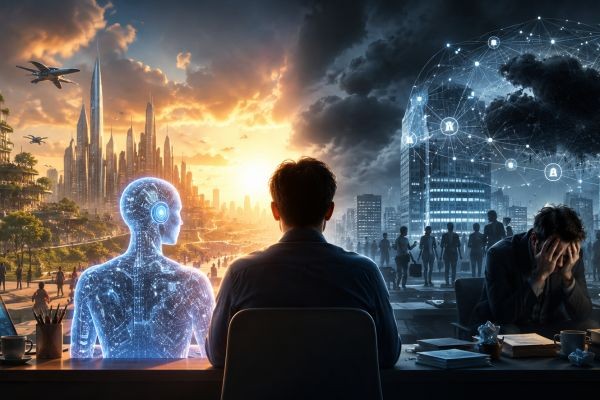
Will AI create more jobs or more anxiety?
The answer may be more complicated than most people realize.
The Fear Behind the Technology
When people say they are worried about AI, they are rarely afraid of the technology itself.
They're afraid of what it means.
A student wonders:
"Will my degree still matter?"
A writer wonders:
"Will companies still hire human creators?"
A programmer wonders:
"Will AI write better code than me?"
An office worker wonders:
"Will my job exist in five years?"
At its core, AI anxiety isn't about machines.
It's about uncertainty.
Humans can handle challenges.
What we struggle with is not knowing what comes next.
History Suggests a Surprising Pattern
This isn't the first time society has faced a technological revolution.
When factories introduced machines during the Industrial Revolution, workers feared unemployment.
When computers entered offices, many believed millions of jobs would disappear.
When the internet arrived, countless traditional businesses worried about becoming irrelevant.
And yet something unexpected happened.
Many old jobs disappeared.
But entirely new industries emerged.
Nobody in 1980 was preparing to become:
-
A social media manager
-
An app developer
-
A digital marketer
-
A cloud engineer
-
A YouTube creator
-
A UX designer
These careers didn't exist yet.
Technology destroyed some opportunities while creating others.
The question is whether AI will follow the same pattern.
Why AI Feels Different
Many experts argue that AI is unlike previous inventions.
The reason?
Previous machines mostly replaced physical labor.
AI can replace certain types of mental labor.
For the first time in history, machines can perform tasks traditionally associated with knowledge workers.
Writing.
Research.
Data analysis.
Coding.
Design.
Translation.
Customer support.
This makes AI feel personal.
It's not just changing factories.
It's changing professions.
And that creates a level of anxiety previous technological shifts didn't generate.
The Rise of "Career Uncertainty"
Perhaps the biggest impact of AI isn't unemployment.
It's uncertainty.
Many people no longer know which skills will remain valuable.
Imagine spending years mastering a profession only to watch software perform parts of it within seconds.
That experience creates a psychological phenomenon known as career uncertainty.
Questions begin to emerge:
-
Am I learning the right things?
-
Should I change careers?
-
Will my expertise become outdated?
-
What happens if technology moves faster than I can adapt?
These questions affect millions of people globally.
And unlike economic challenges, uncertainty often follows us home.
It becomes stress.
Overthinking.
Anxiety.
But AI Is Also Creating New Opportunities
While fear dominates many conversations, another reality is unfolding.
AI is creating entirely new categories of work.
Companies are hiring people for roles that barely existed a few years ago:
-
AI Prompt Engineers
-
AI Trainers
-
AI Auditors
-
AI Ethics Specialists
-
Human-AI Workflow Designers
-
AI Content Strategists
-
Machine Learning Consultants
Beyond these roles, AI is helping entrepreneurs launch businesses faster than ever.
A single creator can now:
-
Build websites
-
Design graphics
-
Create marketing campaigns
-
Generate content
-
Analyze customer data
Tasks that once required entire teams can now be accomplished by individuals with AI assistance.
In some cases, AI is lowering barriers rather than eliminating opportunities.
The Real Divide Won't Be Human vs AI
Many people imagine a future where humans compete directly against machines.
But reality may look different.
The biggest divide may be between:
People who learn to use AI effectively
and
People who refuse to adapt.
Consider two professionals.
One ignores AI entirely.
The other learns how to use AI tools to work faster and smarter.
Who becomes more valuable over time?
Increasingly, success may depend not on competing with AI but collaborating with it.
Anxiety Is Becoming a Modern Workplace Epidemic
Even if AI creates new jobs, anxiety may still increase.
Why?
Because technological change is accelerating.
In previous generations, major workplace shifts happened over decades.
Today, change happens in months.
A tool can become industry standard almost overnight.
Workers constantly feel pressure to:
-
Learn new software
-
Adapt to new systems
-
Upgrade their skills
-
Stay relevant
Many people feel like they're running on a treadmill that never slows down.
The result?
Digital-age anxiety.
Not because opportunities are disappearing.
Because the pace of change is exhausting.
What Skills Are Becoming More Valuable?
Ironically, as AI becomes smarter, distinctly human skills may become more important.
These include:
Creativity
AI can generate ideas.
Humans create original visions.
Emotional Intelligence
Machines process data.
Humans understand emotions.
Critical Thinking
AI can provide answers.
Humans determine which answers matter.
Communication
Technology connects information.
People connect with people.
Adaptability
Perhaps the most valuable skill of all.
The future may belong less to experts and more to learners.
A New Kind of Worker Is Emerging
The traditional employee was valued for knowledge.
The modern employee is increasingly valued for adaptability.
Future professionals may spend less time memorizing information and more time learning how to:
-
Ask better questions
-
Use intelligent tools
-
Solve complex problems
-
Think creatively
-
Work across disciplines
In many ways, AI is changing the definition of expertise itself.
The Hidden Opportunity Inside the Anxiety
Anxiety often signals uncertainty.
But uncertainty also signals possibility.
Nobody knows exactly how AI will reshape the workforce.
That may sound frightening.
Yet it also means the future isn't predetermined.
Entire industries haven't been invented yet.
New careers haven't been named yet.
Problems haven't been solved yet.
For young people especially, this uncertainty contains enormous opportunity.
The individuals who remain curious, flexible, and willing to learn may find themselves creating the jobs of tomorrow rather than searching for them.
So, Will AI Create More Jobs or More Anxiety?
Perhaps the answer is both.
AI will likely create new industries, new careers, and new opportunities that are difficult to imagine today.
At the same time, it will challenge traditional career paths and create uncertainty for millions of workers.
The technology itself isn't inherently optimistic or pessimistic.
It's a tool.
What matters is how society adapts.
The real challenge may not be managing artificial intelligence.
It may be managing human anxiety during a period of unprecedented change.
Final Thoughts
Every generation faces a defining transformation.
For our grandparents, it was industrialization.
For our parents, it was the internet.
For us, it may be artificial intelligence.
The future will almost certainly include smarter machines.
But it will also include human creativity, ambition, resilience, and imagination.
AI may change how we work.
It may change which jobs exist.
It may even change entire industries.
But one thing remains true:
The future has never belonged to those who predicted change perfectly.
It belongs to those who learned how to adapt when change arrived.
And in the age of AI, that ability may become humanity's greatest competitive advantage.